Blog

Why Your Pond Turns Green (And What’s Really Causing Those Toxic Algal Blooms)

You’ve just walked out to check on your beautiful backyard pond, only to find the water has transformed into a thick, murky green soup practically overnight. That shocking moment when crystal-clear water turns into what looks like pea soup isn’t just an aesthetic nightmare—it’s a toxic algal bloom, and understanding what triggers it is your first step toward prevention.
Toxic algal blooms happen when microscopic algae explode in population, releasing harmful toxins that can sicken wildlife, pets, and even humans. While a small amount of algae is normal in any healthy pond ecosystem, certain conditions create the …

Read more Why Your Pond Turns Green (And What’s Really Causing Those Toxic Algal Blooms)

Transform Your Pond Into a Living Masterpiece With Strategic View Framing

Position your favorite garden bench or sitting area where morning light hits the water’s surface at an angle—this creates the most dramatic reflections and transforms an ordinary pond into a living mirror. Walk around your entire property with your morning coffee and identify three distinct viewing points: the spot where you first glimpse the pond, your main relaxation area, and an unexpected angle that guests will discover. Each viewpoint deserves its own carefully composed scene.
Frame your pond like a professional photographer frames a shot. Use layered plantings at different heights to create depth—tall ornamental …

Read more Transform Your Pond Into a Living Masterpiece With Strategic View Framing

Keep Your Pond From Freezing (Without Expensive Heaters)

Wrap exposed plumbing and filter housings with fiberglass batts during freezing weather to prevent cracked pipes and equipment damage that could cost hundreds in repairs. Layer the insulation around vulnerable components, secure it with weatherproof tape, and cover with a protective barrier like plastic sheeting to keep moisture out while trapping heat in.
Insulate the underside of pond bridges and waterfall spillways where heat escapes fastest, creating cold spots that encourage ice formation. Cut fiberglass panels to fit these areas snugly, ensuring you wear gloves and long sleeves to avoid skin irritation from loose fibers.

Read more Keep Your Pond From Freezing (Without Expensive Heaters)

The Predators Stalking Your Pond Fish Right Now (And How to Stop Them)

Install motion-activated deterrents like sprinklers or ultrasonic devices around your pond perimeter to startle herons, raccoons, and other predators before they strike. Position these strategically at common approach points, typically within 6-10 feet of the water’s edge where most predators pause before entering.
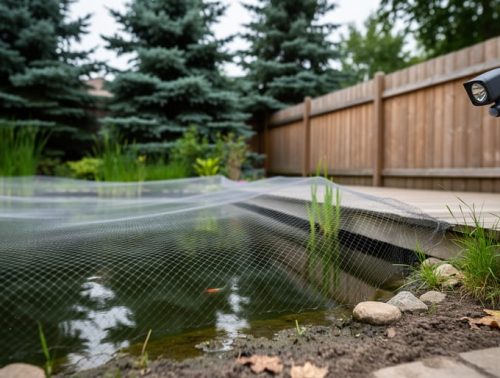
Create physical barriers by stretching pond netting 6-12 inches above the water surface, securing it tightly at ground level with landscape staples or weighted edges. This simple solution stops dive-bombing birds and prevents raccoons from wading in, though you’ll need to check it weekly for tears or sagging …

Read more The Predators Stalking Your Pond Fish Right Now (And How to Stop Them)

Sediment Ponds: The Secret to Crystal-Clear Water Without Constant Maintenance

Cloudy, murky pond water doesn’t mean you’ve failed as a water gardener—it means sediment has built up and needs a strategic management system. A sediment pond is your secret weapon for crystal-clear water: it’s a separate, smaller basin positioned before your main pond that captures dirt, debris, and particles before they cloud up your beautiful water feature.
Think of it as a pre-filter that works with gravity and time rather than expensive equipment. Water flows into this settling basin first, slows down dramatically, and drops its sediment load before moving into your showcase pond. The heavy particles sink …

Read more Sediment Ponds: The Secret to Crystal-Clear Water Without Constant Maintenance

Why Your Backyard Pond Needs a Conservation Easement (And How to Make Wildlife Thrive)

Consider protecting your pond’s wildlife habitat permanently by granting a conservation easement—a legal agreement that restricts future development while keeping you as the owner. This voluntary tool lets you maintain ownership and enjoy your water feature daily while ensuring it remains a sanctuary for frogs, dragonflies, birds, and aquatic plants for generations to come.
A conservation easement works like a protective promise attached to your property deed. You continue living there, swimming in your pond, and tending your water lilies, but you agree not to drain the pond, pave over wetlands, or build structures that …

Read more Why Your Backyard Pond Needs a Conservation Easement (And How to Make Wildlife Thrive)

Your Pond is Already Fighting Climate Change (Here’s How Carbon Sequestration Works)

Your backyard pond is quietly pulling carbon dioxide from the atmosphere and storing it in plant matter, sediment, and algae right now. This natural process, called carbon sequestration, absolutely qualifies as an ecosystem service, and understanding it changes how you manage your water feature.
Ecosystem services are the benefits nature provides that support life and human wellbeing. Scientists categorize them into four types: provisioning services like food and water, regulating services like climate control, supporting services like nutrient cycling, and cultural services like recreation. Carbon sequestration falls squarely into …

Read more Your Pond is Already Fighting Climate Change (Here’s How Carbon Sequestration Works)

Why Your Pond Fish Are Gasping (And How Diffusers Fix It)

Your pond’s murky water, gasping fish, and stubborn algae blooms often point to one invisible culprit: low dissolved oxygen. Without adequate oxygen circulation, beneficial bacteria can’t break down organic waste, fish struggle to breathe, and your once-clear water turns into a cloudy, smelly problem that worsens with each passing week.
Pond aeration diffusers solve this by releasing tiny bubbles from the pond bottom, creating a continuous circulation pattern that oxygenates water throughout the entire water column. Unlike surface fountains that only aerate the top few inches, diffusers work from the bottom up, pushing …

Read more Why Your Pond Fish Are Gasping (And How Diffusers Fix It)

The Sounds of Water: How Musical Elements Transform Your Pondside Experience

Layer the gentle splash of a fountain with wind chimes hung from nearby branches to create your first soundscape. Position a small recirculating waterfall near your seating area where the trickling water naturally masks neighborhood noise and invites relaxation. Add a simple bamboo water spout that produces rhythmic tapping sounds as water fills and empties each segment, bringing meditative percussion to your pondside retreat.
Your water garden already produces music through bubbling aerators, cascading streams, and rustling ornamental grasses, but intentional sound additions transform these natural notes into a complete outdoor …

Read more The Sounds of Water: How Musical Elements Transform Your Pondside Experience

Why Your Pond Water Stays Murky (And the Treatment Design That Finally Fixed Mine)

Map your pond’s unique ecosystem before selecting any equipment by testing water weekly for ammonia, nitrite, and pH levels—problems you can’t see will derail even the most expensive filtration system. Calculate your actual water volume using length times width times average depth, then multiply by 7.5 for gallons, because undersized filters are the number one reason treatment systems fail in backyard ponds.
Design your treatment system in three connected stages: mechanical filtration to catch debris, biological filtration to convert toxic ammonia into safer compounds, and clarification through UV sterilizers or plant …

Read more Why Your Pond Water Stays Murky (And the Treatment Design That Finally Fixed Mine)