Turn Your Backyard Pond Into a Preschool Wonderland (Activities That Actually Work)

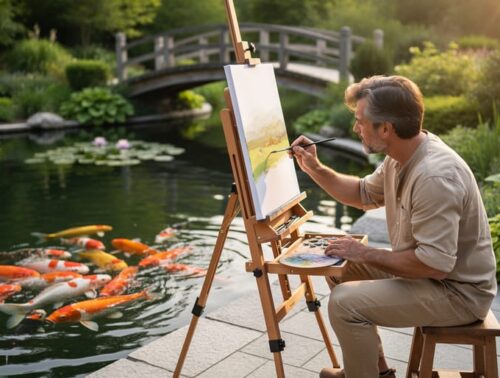
Transform your backyard pond into a living classroom where preschoolers discover nature’s wonders through safe, hands-on exploration. Position children at least three feet back from the water’s edge and establish a firm “look but don’t lean” rule before every pond visit. Equip little learners with child-safe magnifying glasses, plastic containers with lids, and long-handled nets designed specifically for small hands to observe pond life without direct water contact.
Start with simple observation activities that build curiosity without risk. Have children lie on their bellies on a blanket to watch water …

Read more Turn Your Backyard Pond Into a Preschool Wonderland (Activities That Actually Work)

Transform Your Yard with Water Features That Actually Work

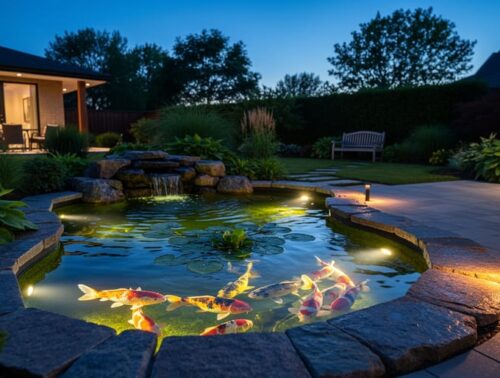
Transform your existing water feature from basic to breathtaking by layering in strategic enhancements that create depth, movement, and ambiance. Start with submersible LED lighting positioned beneath waterfalls or behind rocks to create dramatic nighttime reflections that completely change your yard’s atmosphere after sunset. Add a second pump or fountain head to introduce varied water patterns—the contrast between a gentle bubbler and a cascading stream creates visual interest that keeps your eyes moving across the entire feature.
Expand your feature’s footprint by carving out shallow beach edges where water meets …

Read more Transform Your Yard with Water Features That Actually Work

How Strategic Pond Lighting Transforms Your Nature Pond Into a Biodiversity Haven

Position your pond lights below the waterline or at ground level to minimize sky glow that disorients nocturnal insects and disrupts amphibian breeding cycles. Choose warm-spectrum LEDs under 3000 Kelvin, which produce less blue light than traditional bulbs and cause significantly less interference with wildlife circadian rhythms. Install motion sensors or timers that limit illumination to specific hours when you’re actually enjoying your pond, giving creatures the darkness they need for feeding, mating, and navigation during peak activity times.
Your lighting choices directly impact which wildlife thrives around your water …

Read more How Strategic Pond Lighting Transforms Your Nature Pond Into a Biodiversity Haven

Why Coastal Birds Need Your Backyard Pond (And How to Help Them Thrive)

Transform your backyard pond into a haven for coastal birds by installing shallow gravel beaches along pond edges where shorebirds can safely nest and forage. Create these gently sloping areas using pea gravel or small river rocks, maintaining water depths of 1-3 inches that mimic natural tidal zones where plovers, sandpipers, and terns typically breed.
Establish vegetation buffers using native salt-tolerant grasses and sedges around your pond perimeter to provide critical nesting cover and predator protection. Plant species like saltgrass or rush varieties in clusters 2-3 feet from the water’s edge, creating natural screens …

Read more Why Coastal Birds Need Your Backyard Pond (And How to Help Them Thrive)

Why Your Pond Spillway Could Fail (And How to Design One That Won’t)

Picture this: heavy rain pounds your pond, water rises rapidly, and suddenly you’re watching helplessly as overflow tears through your carefully landscaped banks, creating ugly gullies and threatening nearby structures. This scenario plays out far too often for pond owners who underestimated the importance of proper spillway design—or skipped it entirely.
A spillway isn’t just a nice-to-have feature; it’s the safety valve that protects your entire pond investment. Think of it as the overflow drain in your bathtub, but engineered to handle thousands of gallons during storm events. Without one, even a beautifully …

Read more Why Your Pond Spillway Could Fail (And How to Design One That Won’t)

Your Backyard Pond Needs Security Now (Here’s Why Hackers Care)

Your smart pond system—that automated feeder, Wi-Fi-connected pump controller, or app-managed filtration setup—probably isn’t as secure as you think. Last month, a friend of mine discovered someone had accessed his pond’s automated feeder through a default password he’d never changed, running up his fish food bills and stressing his koi with irregular feeding schedules. It’s a wake-up call many of us need.
Smart pond technology has transformed how we care for our water gardens, letting us monitor water quality, control lighting, and manage filtration from anywhere. But each connected device creates a …

Read more Your Backyard Pond Needs Security Now (Here’s Why Hackers Care)

Keep Disease Out of Your Pond: Simple Biosecurity Steps Every Water Gardener Needs

Quarantine every new fish for at least two weeks in a separate tank before introducing them to your pond—this simple step prevents up to 90% of disease outbreaks that devastate established fish populations. Set up a basic quarantine system using a large plastic tub with an air stone, keeping new arrivals isolated where you can observe them for signs of illness like lethargy, unusual spots, or erratic swimming without risking your entire pond community.
Disinfect all equipment that moves between water sources, including nets, buckets, and testing tools, by soaking them in a 10% bleach solution for ten minutes, then rinsing …

Read more Keep Disease Out of Your Pond: Simple Biosecurity Steps Every Water Gardener Needs

Why Every Pond Owner Needs Water Safety Training (And Where to Find the Best Videos)

Assess your current supervision protocols before students ever step near your water garden by watching training videos that demonstrate proper adult-to-student ratios, emergency response procedures, and safe activity zones around ponds. Look for videos showing real classroom scenarios with educators modeling correct positioning—adults should always place themselves between deeper water and students, maintaining clear sightlines across the entire garden space.
Choose video resources that cover the three-minute rule: instructors must be able to reach any student at the water’s edge within three minutes during activities. This …

Read more Why Every Pond Owner Needs Water Safety Training (And Where to Find the Best Videos)

Why D.E. Filters Keep Your Pond Crystal Clear (Without Harsh Chemicals)

Consider diatomaceous earth filtration if you’re dreaming of crystal-clear pond water that looks like glass. This natural filtration method uses microscopic fossilized algae to trap particles as tiny as 3-5 microns, making it roughly three times more effective than traditional sand filters. Think of D.E. filters as the precision tools of pond keeping—they capture everything from free-floating algae cells to the finest debris that clouds your view of those gorgeous koi.
D.E. filters work by coating grids inside a pressure tank with diatomaceous earth powder, creating a filter bed that water passes through. As your pump pushes…

Read more Why D.E. Filters Keep Your Pond Crystal Clear (Without Harsh Chemicals)

How to Build a Water Garden That Thrives in Any Climate

Layer your water garden with plants at different depths to create a self-sustaining ecosystem that naturally reduces evaporation and maintenance. Position deep-water plants like water lilies in the center at 18-24 inches, marginal plants along edges at 2-6 inches, and floating plants on the surface to shade 40-60% of the water. This collaborative approach mimics natural ponds where plants work together to keep water cool, clear, and oxygen-rich while using less water than traditional landscaping.
Choose plants that share similar water and light requirements within each zone to minimize waste and simplify care. Pair aggressive …

Read more How to Build a Water Garden That Thrives in Any Climate