
What Is a Research Peptide (and What Should Canadian Lab Newcomers Know)?
A research peptide is a short chain of amino acids, usually somewhere between two and fifty, linked together and made for use in laboratory study, much like the products you can find at this store. Think of it like a short length of garden hose: a few connectors snapped together in a set order, much smaller than the big, tangled irrigation network a full protein represents. The order of those links decides everything about how the peptide behaves.
If you’ve just started in a Canadian lab, the vocabulary can feel like a wall. Words like purity, lyophilized, sequence, and certificate of analysis get tossed around as if everyone was born knowing them. They weren’t. I remember staring at my first pond filter manual the same way, wondering what a “bio-media” even was.
This glossary breaks the terms down in plain language, one at a time. You’ll see how peptides are made and checked, which forms and types you’ll run into, and how labs use them in research only. If you want to see how a supplier presents these details in practice, you can browse the guide alongside it. By the end, the paperwork and product labels should read like a clear pond plan, not a puzzle.
What a Research Peptide Actually Means
Think of a peptide as a string of beads, where each bead is an amino acid. Link a handful of beads together and you have a peptide. Link hundreds or thousands into a long, folded chain and you have a protein. The building blocks are the same; the difference is mostly length. Peptides are the short strands, usually somewhere between two and fifty or so amino acids, while proteins are the big, complicated structures.
Now for the “research” part. When a material is labelled for research use, it means it’s intended for study in a controlled laboratory setting. That might be cell cultures, analytical testing, or developing a new lab method. It does not mean the material is meant for people or animals to take.
This is worth saying plainly, because it trips up newcomers. Research-grade peptides are not medications, and they are not supplements. They haven’t been prepared, tested, or approved for that kind of use, and nothing in this glossary is a guide to using them that way. They are lab materials, handled the way you’d handle any other reagent on the bench.
Getting comfortable with these basics now makes every later term easier to follow, a bit like learning what “beneficial bacteria” means before tackling the rest of pond care.
How Peptides Are Made and Checked in the Lab
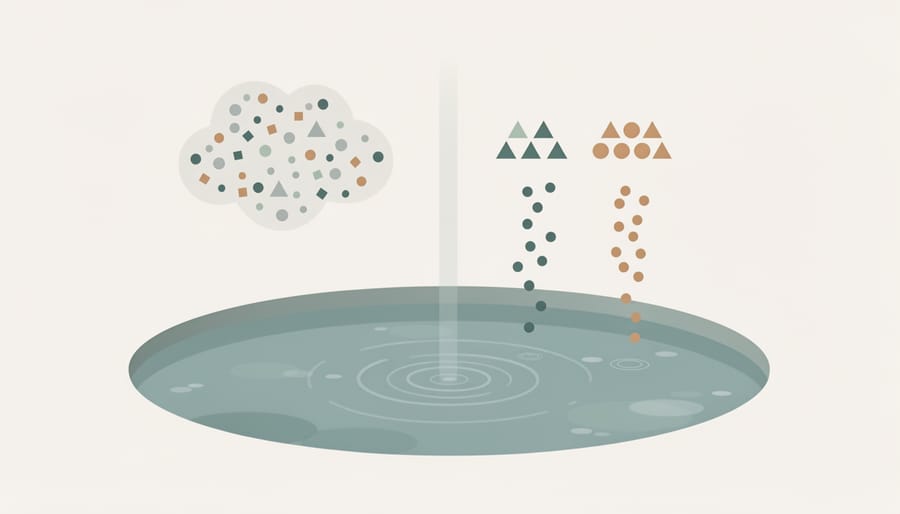
Making a research peptide is a bit like building a chain one bead at a time. Most labs use a method called solid-phase synthesis. The first amino acid gets anchored to a tiny solid resin, then the next amino acids are added in order, one after another, until the full sequence is built. Once the chain is finished, it’s released from the resin, and that’s when the real checking begins.
The raw product is a mix of the peptide you wanted plus a few unwanted fragments. Purification, usually by a technique called HPLC, separates the target peptide from the leftovers. Then identity testing, often mass spectrometry, confirms you actually have the right molecule.
Why does this matter? Think of water quality testing for a pond. You wouldn’t trust clear-looking water without a test strip, and you shouldn’t trust a vial just because the label says so. Testing tells you what’s really inside and how much of it is the stuff you intended.
The results usually arrive on a document called a certificate of analysis, often shortened to COA. It looks technical at first, but it follows a predictable pattern. Here’s what you’ll typically find on one:
- The peptide name and its amino acid sequence
- A batch or lot number for traceability
- The purity percentage
- The testing methods used, such as HPLC and mass spectrometry
Once you know where to look, a COA stops being intimidating and becomes a handy snapshot of what you’re working with.
The Glossary: Terms You’ll Hear in a Canadian Peptide Lab
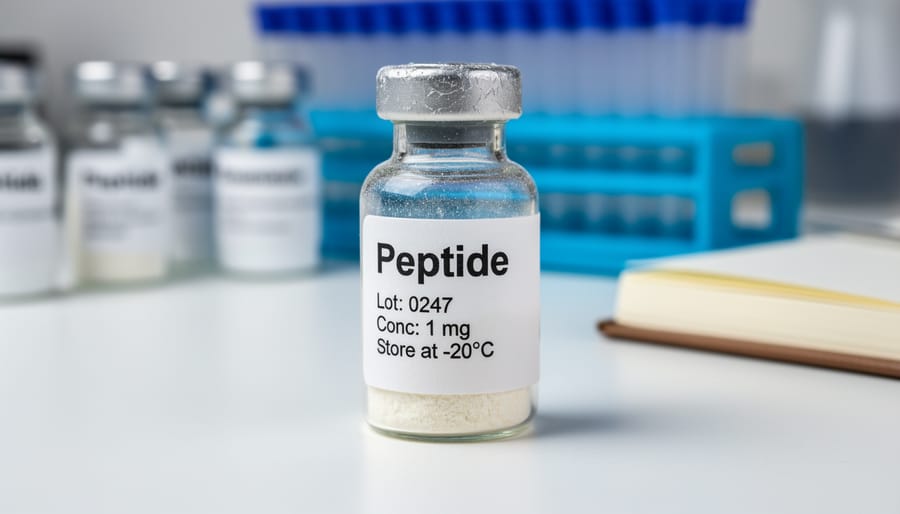
Think of this as the pond-test chart pinned to the shed wall: a quick reference you can glance at when a new word pops up. Here are the terms you’ll hear most often, listed alphabetically so they’re easy to find again.
- Amino acid
- The basic building block of a peptide. Think of it as a single bead; a peptide is a string of them.
- Certificate of analysis
- A document from the supplier showing the test results for a specific lot, such as purity and identity. It’s the lab’s equivalent of a water-test report.
- HPLC
- Short for high-performance liquid chromatography, a method that separates a sample into its parts so you can see how pure it is. Results usually show up as a chart with peaks.
- Lot or batch number
- An identifier for a particular production run. Record it every time, so you can trace any material back to its paperwork.
- Lyophilized
- Freeze-dried. The water has been gently removed, leaving a dry powder that is usually more stable for storage and shipping.
- Mass spectrometry
- A technique that measures the weight of molecules to confirm a peptide is what it’s supposed to be. It answers the identity question.
- Purity
- The percentage of the material that is the intended peptide rather than leftovers from making it. Higher numbers mean fewer unwanted extras.
- Reconstitution
- Adding a liquid to a freeze-dried peptide so it can be used in lab work. Always follow your protocol and the supplier’s documentation.
- Residue
- An amino acid once it’s linked into a chain. People often say “the third residue” to point to a specific position.
- Sequence
- The order of amino acids in a peptide, written out from one end to the other. Change the order and you have a different peptide.
- Solvent or diluent
- The liquid used to dissolve or dilute a peptide. Which one is appropriate depends on the peptide and the experiment, so check your protocol.
- Terminus (N-terminus and C-terminus)
- The two ends of a peptide chain. The N-terminus is the start, the C-terminus is the finish, and sequences are normally read from N to C.
A few of these pair up nicely, which helps them stick. Purity and identity go hand in hand: HPLC tells you how clean the sample is, while mass spectrometry tells you what it actually is. Likewise, lyophilized and reconstitution are two sides of the same coin, since one describes the dry form and the other describes what happens before it’s used.
Don’t worry about memorizing everything on day one. Even experienced researchers double-check a term now and then, much like a seasoned pond keeper rereading the test-kit instructions. If a word on a label or document still doesn’t make sense, ask your supervisor or a more experienced colleague. That’s how everyone learns it.
Types of Peptide Materials and Forms You’ll Come Across
Once you start reading labels and catalogues, you’ll notice research peptides arrive in a few common forms. Knowing the differences helps you handle and record them correctly.
Freeze-dried powder versus solutions. Most peptides ship as lyophilized (freeze-dried) powder, which is usually more stable for storage and transport. Some suppliers also provide ready-made solutions, but those typically have a shorter shelf life and stricter storage needs. Always check the label for the form and the supplier’s storage guidance.
Standard versus modified peptides. A standard peptide is just the amino acid sequence. A modified one has an added chemical tweak, such as a capped end or an attached group, which can change how it behaves. If the name or label mentions a modification, note it in your records.
Short fragments versus longer sequences. Short synthetic fragments are generally quicker to make and easier to verify. Longer sequences are harder to produce, so purity documentation matters even more.
Labelled versus unlabelled peptides. Labelled peptides carry a tag, like a fluorescent dye or isotope marker, so researchers can track them in an experiment. Unlabelled ones don’t. Think of it like a tagged fish in a pond survey: the tag lets you follow it, but you have to know it’s there. Make sure the label type is clearly written on every vial and in your notes.
How Research Peptides Are Used in Laboratory Work
Once you know the vocabulary, the next question is what people actually do with these materials. In a controlled laboratory, research peptides tend to show up in a handful of everyday jobs.
In cell-culture studies, researchers add carefully prepared peptide solutions to cells growing in dishes to observe how the cells behave. Assay development is another big one: a peptide can serve as a known ingredient while a team builds and fine-tunes a new test. Analytical labs often use peptides as reference standards, a trusted sample you compare unknowns against, a bit like using a calibrated test kit to check your pond water.
Peptides also turn up in basic biochemical research, where scientists study how molecules bind, fold, and interact. If you enjoy seeing how small structures shape bigger systems, biofilms explained is a nice parallel from the water garden world.
All of this happens in controlled settings, following institutional protocols and supplier documentation.
Canadian Context: Rules, Labelling, and Responsible Handling
Working in a Canadian lab adds a few layers beyond the science itself, and it helps to know them early. The first thing to watch for is research-use-only labelling. Vials and paperwork for these materials should clearly state they’re intended for laboratory research, not for people or animals. If a label or product page suggests anything else, that’s a red flag worth raising with your supervisor.
Where your materials come from matters just as much. Stick with reputable suppliers who provide documented testing, such as a certificate of analysis and a clear lot number for every batch. Think of it like buying pond treatments: you want to know what’s actually in the bottle before it goes anywhere near your water.
Your institution is part of the picture too. Most Canadian labs have a safety office, a supervisor, and written policies covering ordering, storage, and disposal. WHMIS training is the standard way workers learn to read hazard labels and safety data sheets, so make sure yours is current. If you’re new to all this, our guide to lab safety basics is a friendly place to build good habits.
Finally, don’t assume the rules stay still. Requirements can change, so check the current expectations with your institution’s safety office and with Health Canada directly. A quick conversation now saves a lot of confusion later.
Handling and Storage Basics for Newcomers
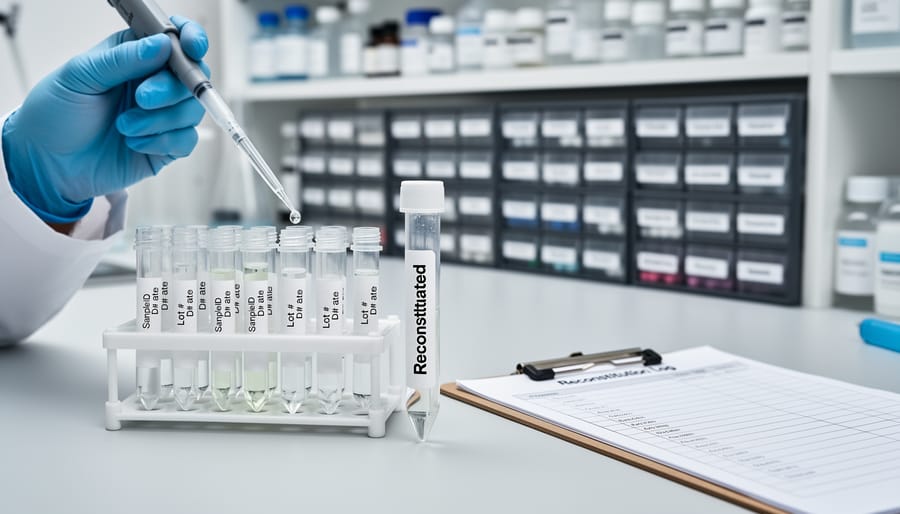
Good handling habits start the moment a package arrives, and they’re easier to build than you might think. Think of it like a pond maintenance log: a few quick notes now save a lot of head-scratching later.
1. Check the label on arrival. Confirm the name, lot number, and research-use-only marking match your order and paperwork.
2. Record the lot number. Write it in your lab notebook alongside the date received and who received it.
3. Store as the supplier directs. Follow the datasheet or certificate of analysis for temperature and light, and check your own lab protocol too.
4. Avoid repeated freeze-thaw cycles. Each round can degrade the material, so ask your supervisor how your lab handles aliquoting.
5. Keep clear records. Log every use, storage change, and observation.
Careful record-keeping is a bit like sensor calibration for your pond: sensor calibration only helps if you write down what you did. When in doubt, defer to supplier documentation and your lab’s written procedures.
Common Questions From Lab Newcomers
Every newcomer asks the same handful of questions, and none of them are silly. Here are the ones that come up most, answered plainly.
How is a peptide different from a protein?
It mostly comes down to size. Peptides are short chains of amino acids, while proteins are much longer chains that fold into complex shapes. There’s no hard cutoff, but think of a peptide as a short string of beads and a protein as a very long, tangled one.
What does a purity number actually tell me?
It shows what share of the material is the target peptide, usually measured by HPLC. A figure like 98% means most of what’s in the vial is the right sequence, and the rest is leftover or related material. Check the certificate of analysis to see how that number was measured.
What does “lyophilized” mean?
It simply means freeze-dried. The peptide arrives as a dry powder, which keeps it stable until you reconstitute it in a suitable solvent.
Where should I look for reliable documentation?
Start with the supplier’s certificate of analysis and the lot or batch number on your vial. If anything looks incomplete, ask your supervisor or your institution’s safety office before you go further.
If a term still feels fuzzy after all that, keep asking. Even experienced researchers double-check definitions now and then, and a good lab team will always make room for a quick question.
Learning peptide vocabulary feels a lot like learning pond terms for the first time. Early on, words like “lyophilized” or “certificate of analysis” can feel as unfamiliar as “biofilm” or “dissolved oxygen” did when you first set up a water garden. Give it a few weeks of seeing these terms on labels, paperwork, and protocols, and they start to feel like old friends.
So bookmark this glossary and come back to it whenever a word trips you up. Nobody expects a newcomer to know everything, and the best researchers are the ones who keep asking questions. Your supervisor, lab manager, and institution’s safety staff are there to help, so lean on them freely.
When you need facts, trust documented, reputable sources: supplier paperwork, lab protocols, and official guidance. Take it one term at a time, stay curious, and you’ll be speaking the language with confidence before you know it.