
See Your Pond’s Hidden World: A Simple Chart for Identifying Microscopic Life
Peer into the fascinating microscopic world teeming beneath your pond’s surface – a hidden ecosystem where countless tiny organisms dance, swim, and interact in an intricate ballet of life. Understanding these microscopic creatures isn’t just a window into nature’s complexity; it’s your key to maintaining a healthy, balanced pond ecosystem. From graceful rotifers spinning through the water to industrious water fleas filtering debris, each organism plays a crucial role in your pond’s health. This comprehensive guide will help you identify and understand the most common microscopic pond dwellers, interpret what their presence means for your water quality, and harness their natural behaviors to maintain crystal-clear water. Whether you’re a curious hobbyist or a dedicated pond keeper, mastering microscopic pond life identification will transform how you view and care for your aquatic paradise. Get ready to explore a world where a single drop of pond water becomes an entire universe of discovery.
Common Microscopic Pond Creatures and Their Habitats
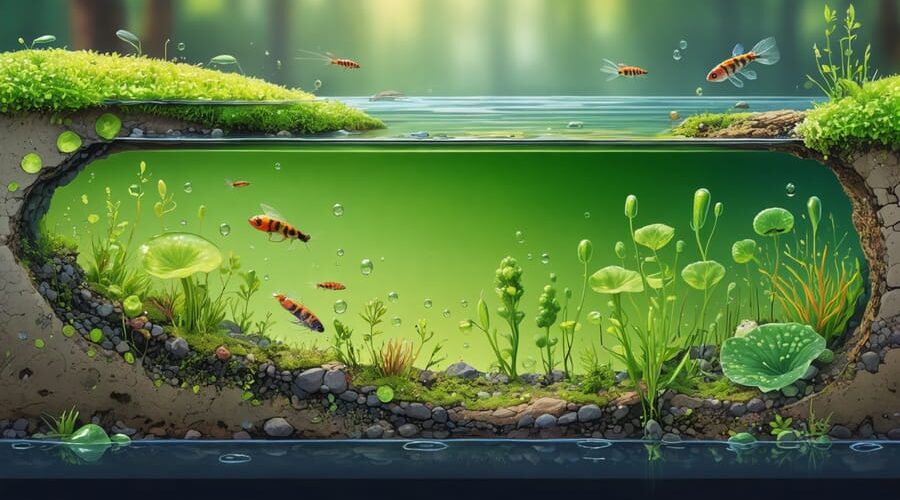
Split-view illustration showing different layers of pond water and typical organisms found in each zone
Understanding where microscopic creatures live in your pond starts with recognizing that pond water isn’t uniform. It’s divided into distinct vertical layers, each with its own environmental conditions and resident organisms. These pond microhabitats create specialized niches where different species thrive based on their oxygen requirements, light preferences, and feeding strategies.
The three primary zones in any pond are the surface layer (where the water meets air), the mid-water column (the open water between surface and bottom), and the benthic zone (the substrate and bottom sediments). Each supports its own community of microscopic life. Surface dwellers take advantage of oxygen-rich conditions and direct sunlight, while bottom-dwelling organisms have adapted to lower light and variable oxygen levels.
| Pond Layer | Depth Range | Light & Oxygen | Typical Organisms |
|---|---|---|---|
| Surface | Top 0-5 cm | High light, oxygen-saturated | Volvox, water striders, surface algae |
| Mid-water | 5-50 cm | Moderate light, variable oxygen | Daphnia, copepods, rotifers, free-swimming algae |
| Bottom (Benthic) | Substrate level | Low light, lower oxygen | Ostracods, midge larvae, bottom-dwelling protozoans |
Recognizing these habitat categories helps you predict where to find specific organisms when sampling. A scoop from the surface film will reveal entirely different creatures than a sample drawn from near the bottom sediments, and understanding these patterns is essential for accurate identification.
Surface Layer Dwellers
The surface film of your pond is a fascinating pond microhabitats teeming with unique organisms. These surface dwellers, often visible to the naked eye, include water striders and whirligig beetles that skate across the water’s surface. Through your microscope, you’ll discover an even more incredible world of microscopic life.
Look for the distinctive Euglena, a single-celled organism that appears green and moves with a whip-like flagellum. You might also spot Volvox colonies – beautiful spherical groups of algae that roll through the water like tiny green balls. Coleps, barrel-shaped protozoans with armor-like plates, are another common sight.
To observe these surface creatures, gently skim the top layer of pond water with a clean container. Avoid disturbing the water too much, as these organisms are quite delicate. Place a drop on your slide and look for swift-moving organisms that tend to gather near air bubbles or debris. These surface dwellers play crucial roles in your pond’s ecosystem, feeding on bacteria and serving as food for larger organisms.
Mid-Water Column Inhabitants
The mid-water column of your pond is home to some of the most fascinating and active microscopic creatures. These free-swimming organisms, often called planktonic life, dart and glide through the water with surprising grace. Common inhabitants include the lightning-fast paramecium, which uses tiny hair-like cilia to propel itself through the water, and the elegant vorticella, which attaches itself to floating debris by a spring-like stalk.
You’ll also find various species of rotifers spinning their wheel-like corona to create feeding currents, and the peculiar euglena, which can switch between plant-like photosynthesis and animal-like feeding. Water fleas (Daphnia) are slightly larger but still microscopic, moving through the water with a distinctive hopping motion.
These mid-water swimmers are excellent indicators of pond health. A diverse population usually suggests good water quality, while a sudden decrease might signal environmental stress. When viewing these creatures under your microscope, focus on different water depths to catch glimpses of their natural behaviors and movements.
Bottom-Dwelling Microlife
The bottom layer of your pond is teeming with fascinating microorganisms that play crucial roles in maintaining ecosystem balance. These sediment-dwellers include nematodes, which look like tiny transparent worms, and tardigrades (water bears) that waddle through the muck with their eight stubby legs. Near plant roots, you’ll find colonial vorticella swaying on their stalks like miniature bells, and tube-dwelling rotifers that create protective homes from debris.
Look for the distinctive spiral-shaped trumpet animalcules, which anchor themselves to decaying plant matter, and the graceful swimming of gastrotrichs as they glide through the sediment. These bottom-dwelling creatures are essential decomposers, breaking down organic matter and recycling nutrients back into the pond system. When viewing samples, gently stir the sediment with your pipette to reveal these hidden inhabitants, but let the sample settle for a few minutes before observing.
Using Your Identification Chart
Basic Shape Recognition
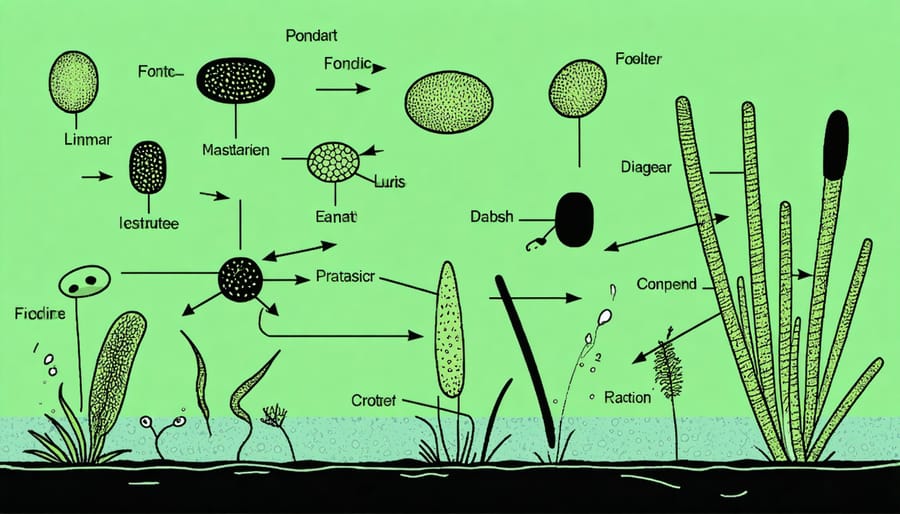
When you first peer through your microscope, you’ll notice that pond microorganisms typically fall into several distinct shape categories. Round or oval organisms are often protozoans like paramecium or colonies of algae. These tend to move in smooth, gliding motions through the water. Look for elongated, worm-like shapes that could indicate rotifers or nematodes, which typically wiggle or contract as they swim.
Bell-shaped organisms, such as vorticella, usually attach themselves to debris or other surfaces, creating a characteristic swaying movement. Keep an eye out for geometric shapes too – perfect circles might be diatoms, while triangular or rectangular forms could be various algae species.
Movement patterns are just as important as shapes for identification. Some organisms spin or rotate while swimming, others dart quickly across your field of view, and some merely drift along with the current. Ciliates, for instance, often move in spiral patterns, while flagellates tend to move more erratically with sudden changes in direction.
Pay attention to any visible structures like hair-like cilia, whip-like flagella, or protective shells. These features, combined with the basic shape and movement pattern, can help narrow down your identification. For example, euglenoids are typically elongated and move with a characteristic wobbling motion, while water bears (tardigrades) have a distinct chunky, segmented appearance and move with a slow, deliberate crawling motion.
Remember that many organisms can change their shape slightly as they move, feed, or respond to stimuli, so observe them for at least a few minutes to get a complete picture of their characteristics.
| Shape Category | Common Organisms | Movement Pattern | Key Features |
|---|---|---|---|
| Round/Spherical | Paramecium, Volvox colonies | Smooth gliding, rolling motion | Hair-like cilia covering surface, may appear green if algae |
| Elongated/Worm-like | Rotifers, nematodes, euglenoids | Wiggling, contracting, characteristic wobbling | Segmented body, visible flagellum, contractile movements |
| Bell-shaped | Vorticella, Stentor | Swaying while attached, sudden contractions | Stalk attachment, ring of cilia around opening |
| Geometric/Angular | Diatoms, desmids | Slow drifting, minimal active movement | Glass-like shells, bilateral symmetry, perfect circular or rectangular forms |
Size and Color Guidelines
When identifying microscopic pond life, understanding size relationships and color patterns is crucial for accurate identification. Most pond microorganisms range from 0.02 to 2 millimeters in size, which is why they’re typically invisible to the naked eye. To help you get perspective, imagine that a human hair is about 0.1 millimeters thick – many pond organisms are even smaller than that!
Color can be a reliable indicator of what you’re observing. Green organisms are often algae or plant-like protozoans containing chlorophyll. Brown or golden-brown creatures are typically diatoms, while reddish tints might indicate the presence of certain types of rotifers. Clear or translucent organisms are common and include many types of water fleas and copepods.
When using your microscope, start with lower magnification (40x) to spot larger organisms like water fleas, then gradually increase to higher powers (100x-400x) for smaller creatures like paramecium and amoeba. Keep in mind that lighting can affect how colors appear under the microscope, so use natural or white light for the most accurate observations.
A helpful tip is to use familiar objects as size references. For example, a paramecium is typically about the size of a printed period on this page, while a water flea might be as large as the tip of a sharpened pencil. Creating these mental size relationships helps build your identification skills over time.
Remember that size and color can vary based on environmental conditions, life cycle stages, and even the organism’s diet, so use these guidelines alongside other identifying features for the most accurate results.
What Your Microscopic Life Tells You About Pond Health
The tiniest inhabitants of your pond reveal more about its health than most visible features ever could. Microscopic organisms function as living sensors, their presence, abundance, and diversity offering a detailed snapshot of water quality and ecosystem balance. When you learn to identify these minute creatures, you’re essentially reading your pond’s medical chart.
Clean, well-oxygenated water supports a rich community of protozoa, rotifers, and beneficial bacteria. These microhabitats harbour different species depending on conditions like dissolved oxygen, pH, and nutrient levels. A healthy pond displays remarkable microscopic diversity, with predatory ciliates keeping bacterial populations in check and algae-eating zooplankton preventing bloom formation.
Pollution and poor water quality dramatically shift these populations. High nutrient levels from excess feeding or runoff trigger explosive growth of certain algae species while suppressing others. Low oxygen conditions favour anaerobic bacteria that produce foul-smelling compounds. The sudden disappearance of sensitive species like paramecia or the dominance of pollution-tolerant organisms like certain flagellates signals trouble before you notice cloudy water or fish distress.
Temperature fluctuations, chemical contamination, and seasonal changes all leave distinct fingerprints in your pond’s microscopic community. Understanding these patterns helps you maintain a thriving food web from the bottom up. Regular microscopic monitoring catches problems early, often weeks before they affect larger organisms.
The beauty of using microscopic life as bioindicators lies in their rapid reproduction and swift response to environmental changes. While fish or frogs might take days or weeks to show stress, microscopic populations shift within hours. Supporting diverse microhabitats creates refuges for sensitive species and maintains the biological stability that all pond life depends on.
Healthy Pond Indicators
A healthy pond is like a well-orchestrated symphony, where various microscopic organisms play their unique roles in maintaining balance. When you spot water fleas (Daphnia) and copepods dancing through your pond water, that’s excellent news! These tiny crustaceans are nature’s cleanup crew, feeding on algae and helping maintain crystal-clear water.
Rotifers are another welcome sight, as they’re particularly sensitive to water quality. Their presence typically indicates clean, well-oxygenated conditions. You’ll also want to keep an eye out for diverse protozoans like Paramecium and Vorticella – these single-celled organisms are vital players in the aquatic food web and help break down organic matter.
Healthy ponds usually display a good mix of green algae species rather than dominated by any single type. Look for euglenoids too – these fascinating organisms combine plant-like and animal-like characteristics, and their presence often signals balanced nutrient levels.
If you spot water bears (tardigrades) or healthy populations of ciliated protozoa, you’re likely doing something right! These creatures thrive in clean water conditions and contribute to the natural filtration process. Remember, diversity is key – a healthy pond should host a variety of microscopic life rather than showing dominance of any single species.
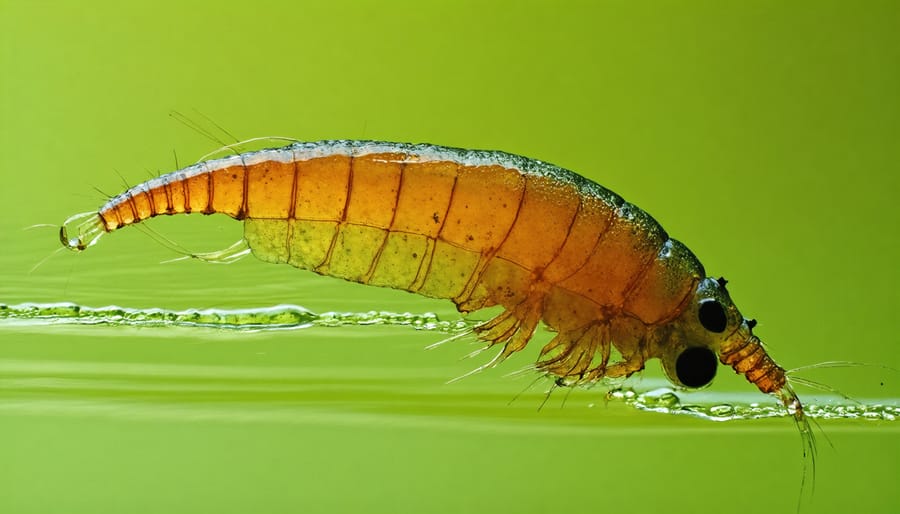
- Water fleas (Daphnia)indicate clean, well-oxygenated water with balanced nutrient levels
- Copepodssignal good oxygen content and help control algae populations
- Rotifershighly sensitive to pollution; presence confirms excellent water quality
- Paramecium and Vorticellakey decomposers that break down organic matter efficiently
- Green algae diversityhealthy mix rather than single-species dominance shows balanced conditions
- Euglenoidspresence indicates balanced nutrient levels and stable pH
- Water bears (Tardigrades)thrive in clean water; excellent filtration indicator
- Ciliated protozoa populationscontribute to natural filtration and nutrient cycling
Warning Signs to Watch
While most microscopic pond life is beneficial, certain organisms can signal potential problems in your pond’s ecosystem. An abundance of euglenoids, which appear as small green swimmers under the microscope, often indicates high levels of organic pollution or excess nutrients in the water. Similarly, if you spot large numbers of vorticella (bell-shaped organisms attached to stems), this could mean your pond has too much organic waste.
Keep an eye out for an overwhelming presence of rotifers, as these filter feeders multiply rapidly in waters with high bacterial content. While some rotifers are normal and healthy, excessive populations suggest poor water quality. Blue-green algae (cyanobacteria) are particularly concerning – if you notice these small, cylindrical organisms forming chains or clusters, immediate action may be needed as they can produce harmful toxins.
A sudden explosion of paramecium populations often signals decomposing organic matter, while unusually high numbers of nematodes (tiny worms) might indicate poor oxygen levels. Watch for water fleas disappearing from your samples, as these crucial organisms are sensitive to water quality changes and their absence can be an early warning sign of problems.
Remember, it’s not about eliminating these organisms completely – rather, monitoring their populations helps maintain a healthy balance in your pond ecosystem.
Simple Steps to Support Your Pond’s Microscopic Life
Creating a healthy environment to support pond microorganisms doesn’t have to be complicated. These tiny creatures are essential for your pond’s ecosystem, and with a few simple steps, you can help them thrive.
First, maintain proper water circulation. A gentle flow keeps oxygen levels balanced and prevents stagnant areas where harmful bacteria might multiply. A small fountain or waterfall works perfectly, but avoid strong currents that might disturb the delicate balance.
Add plenty of aquatic plants to your pond. Plants provide surfaces for beneficial microorganisms to colonize and offer shelter for larger creatures that feed on them. Try including both submerged and floating varieties. Water lilies, hornwort, and duckweed are excellent choices that also help maintain water quality.
Monitor your pond’s nutrient levels regularly. Too many nutrients can lead to algae blooms, while too few might starve your microscopic friends. Add organic matter moderately – fallen leaves and plant debris provide food for microorganisms, but don’t overdo it. Remove excess debris before it breaks down completely.
Light management is crucial. While some sunlight is necessary, too much can cause temperature spikes and encourage excessive algae growth. Aim for partial shade, perhaps using floating plants to create natural cover. This creates diverse microhabitats where different species can flourish.
Avoid using harsh chemicals or algaecides unless absolutely necessary. These products don’t discriminate between harmful and beneficial microscopic life. Instead, focus on natural balance through proper filtration and plant life. If you must treat your pond, choose targeted solutions that won’t harm the beneficial organisms.
Patience is key – a healthy microscopic ecosystem takes time to establish. Regular observation with your microscope will help you understand the changing dynamics of your pond’s tiny inhabitants. Keep a log of what you see and how it changes with the seasons. This knowledge will help you make better decisions about pond maintenance and ensure your underwater world stays vibrant and healthy.
Remember, these microscopic creatures are your allies in maintaining a clear, healthy pond. By following these simple steps, you’ll create an environment where both visible and invisible life can thrive together harmoniously.
Understanding microscopic pond life opens up a fascinating world beneath the water’s surface and plays a crucial role in maintaining a healthy pond ecosystem. By learning to identify these tiny organisms, you become a better steward of your water garden and can spot potential issues before they become serious problems. Regular observation of your pond’s microscopic inhabitants helps you understand seasonal changes and the overall health of your aquatic environment. Remember that every drop of pond water contains an entire universe of life, and each organism plays its vital role in the ecosystem. Keep observing, learning, and documenting what you find – your understanding of these miniature marvels will grow with each viewing, making pond keeping an even more rewarding hobby.
- Install gentle water circulation. Set up a small fountain or waterfall to keep oxygen levels balanced and prevent stagnant areas where harmful bacteria might multiply. Avoid strong currents that could disturb the delicate balance.
- Plant diverse aquatic vegetation. Add both submerged and floating plant varieties throughout your pond. Water lilies, hornwort, and duckweed provide surfaces for beneficial microorganisms to colonize while offering shelter for larger creatures that feed on them.
- Monitor and balance nutrient levels. Test your water regularly to prevent algae blooms from excess nutrients or starvation from too few. Add organic matter like fallen leaves moderately, and remove excess debris before it breaks down completely.
- Create partial shade coverage. Use floating plants to provide natural cover, aiming for a balance between necessary sunlight and shade. This prevents temperature spikes, controls excessive algae growth, and creates diverse microhabitats where different species can flourish.
- Prioritize natural balance over chemicals. Avoid harsh algaecides that kill beneficial microscopic life along with harmful organisms. Focus instead on proper filtration and plant life. If treatment becomes necessary, choose targeted solutions that preserve beneficial organisms.
- Observe and document changes over time. Use your microscope regularly to track your pond’s tiny inhabitants. Keep a log of what you see and how it changes with the seasons to make better maintenance decisions.