
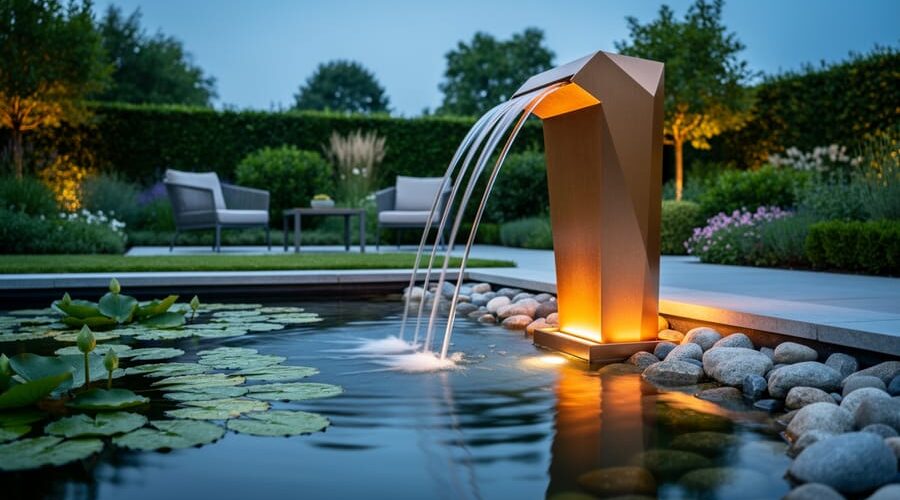
How Artistic Water Fountains Transform Your Garden Into a Living Masterpiece
Picture your garden pond transformed by dancing water that catches sunlight like liquid crystal, or imagine evening gatherings where illuminated streams arc gracefully above the water’s surface. Artistic water fountains turn ordinary backyard ponds into living sculptures that engage all your senses—the visual drama of cascading water, the soothing soundtrack of splashes and trickles, even the refreshing mist on warm afternoons.
Unlike basic pump-and-spray setups, artistic fountains make bold design statements. You might choose a classical tiered fountain that evokes European gardens, a modern geometric sculpture with angular water jets, or a naturalistic rock formation that looks like it sprouted from the earth itself. The beauty lies in how these features become focal points that draw the eye and invite people to linger.
But here’s what makes this project especially rewarding for DIY water gardeners: installing an artistic fountain doesn’t require professional expertise or a massive budget. With today’s submersible pumps, adjustable nozzles, and modular fountain kits, you can create stunning water displays using weekend-friendly techniques. Whether you’re working with an existing pond or starting fresh, the right fountain transforms still water into dynamic art.
This guide walks you through everything from selecting a fountain style that matches your aesthetic vision to tackling the practical details of pump sizing, electrical connections, and seasonal care. You’ll discover how to balance artistic ambition with realistic installation, creating a water feature that looks professionally designed but carries the satisfaction of being uniquely yours.
Why Water Fountains Are More Than Just Decoration
When I first added a fountain to my backyard pond, I’ll admit I was mostly thinking about how pretty it would look. What I didn’t expect was discovering all the wonderful ways it actually improved my entire water garden ecosystem. Turns out, artistic fountains are working overtime in ways you might not realize!
Let’s talk about what’s happening beneath that beautiful spray. Every time water droplets cascade back into your pond, they’re pulling oxygen from the air and mixing it into the water. This oxygenation for fish and plants is absolutely essential for keeping your aquatic friends healthy and your water plants thriving. Think of your fountain as a constant breathing exercise for your pond—it’s keeping everything fresh and lively.
Here’s a bonus I learned the hard way after one mosquito-filled summer: moving water means no mosquitoes! These pesky insects need still water to lay their eggs, so your fountain’s gentle movement acts as a natural pest control system. No chemicals needed, just continuous flow.
Then there’s the calming effect that surprised me most. After a stressful day, I find myself drawn to sit near my fountain, listening to the gentle splashing sounds. Those sound therapy benefits aren’t just in my head—the rhythmic water sounds actually help mask neighborhood noise and create a peaceful atmosphere that melts away tension.
Finally, fountains naturally draw the eye and give your garden a sense of purpose and design. Whether you’re hosting friends or simply enjoying your morning coffee outside, that dancing water becomes the star of the show, tying together all your landscaping efforts into one cohesive, beautiful scene. It’s function meeting art in the most delightful way possible.
Understanding Different Fountain Styles for Your Water Garden
Classical and Formal Fountains
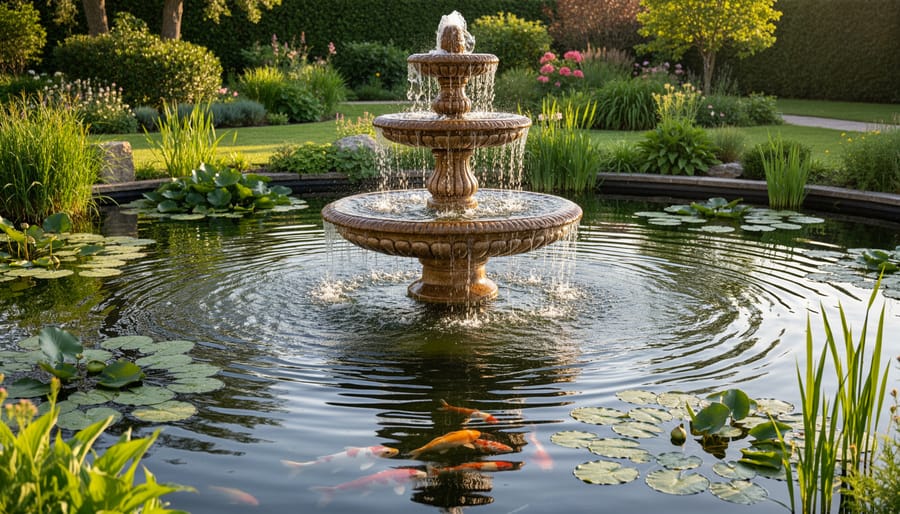
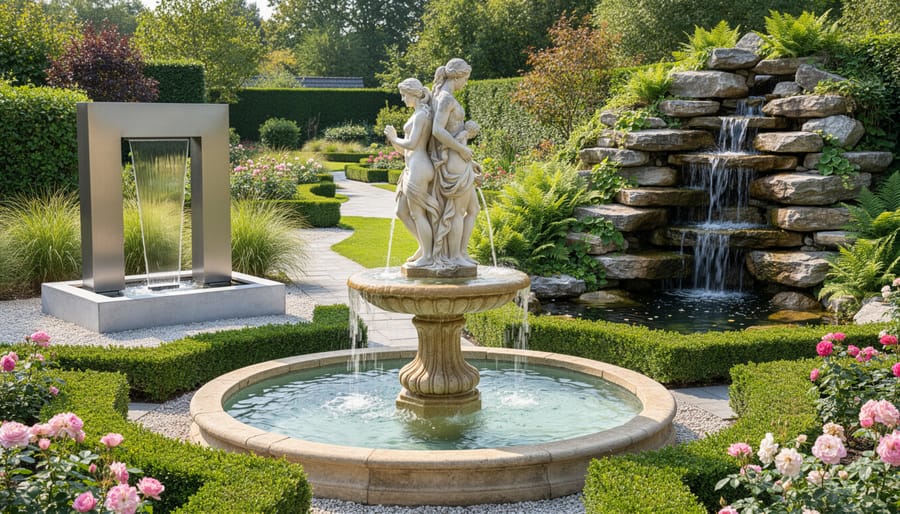
There’s something timelessly elegant about classical fountain designs that never goes out of style. These are the fountains you picture in grand estates and formal gardens—tiered bowls cascading gracefully downward, cherub statuary pouring water from urns, or lions’ heads spouting water into reflecting pools.
Tiered fountains work beautifully in medium to large gardens where they can serve as commanding centerpieces. They’re particularly stunning in formal layouts with symmetrical plantings, brick pathways, or manicured hedges. For pond integration, position these fountains near the water’s edge or on a stable platform within the pond itself if it’s at least 6 feet across.
Material choice significantly impacts both appearance and longevity. Natural stone fountains exude authentic elegance but come with a higher price tag and weight considerations. Concrete offers durability at a more accessible cost and weathers beautifully over time. Resin fountains have become incredibly realistic-looking while remaining lightweight and budget-friendly—perfect for DIY installation without requiring heavy equipment.
I’ve installed a concrete three-tiered fountain in my own garden, and watching it develop a natural patina over the seasons has been genuinely rewarding. These classical pieces create instant sophistication while the sound of cascading water adds that peaceful ambiance we all crave in our outdoor spaces.
Contemporary and Modern Fountain Art
Modern fountains have completely transformed outdoor spaces, and I couldn’t be more excited about the possibilities they offer! Today’s contemporary designs break free from traditional styles, embracing clean lines, geometric shapes, and minimalist aesthetics that work beautifully with modern landscaping.
Think sleek stainless steel columns with water cascading down smooth surfaces, or bold rectangular basins with water emerging from unexpected angles. These pieces aren’t just water features—they’re sculptural statements that command attention in your garden. I’ve seen simple cube-shaped fountains create stunning focal points in minimalist Japanese-inspired gardens, while abstract metal sculptures with integrated water elements add an artistic edge to contemporary patios.
What I love about modern fountains is their versatility. They complement hardscaping materials like concrete, stone pavers, and architectural plants with striking foliage. The key is choosing pieces that echo your home’s architectural style. A spherical fountain with precise water jets suits mid-century modern homes, while angular designs with LED lighting create drama in urban courtyards.
These fountains also tend to be DIY-friendly, with many featuring straightforward installation and self-contained systems. The clean designs mean less maintenance hassle too—no intricate crevices collecting debris. Whether you’re working with a small balcony or spacious yard, contemporary fountains offer endless creative possibilities for making your outdoor space truly distinctive.
Natural and Organic Fountain Designs
If you’re dreaming of a water feature that looks like it’s always been part of your garden, natural and organic designs are your perfect match. These fountains work beautifully because they don’t fight against nature—they celebrate it.
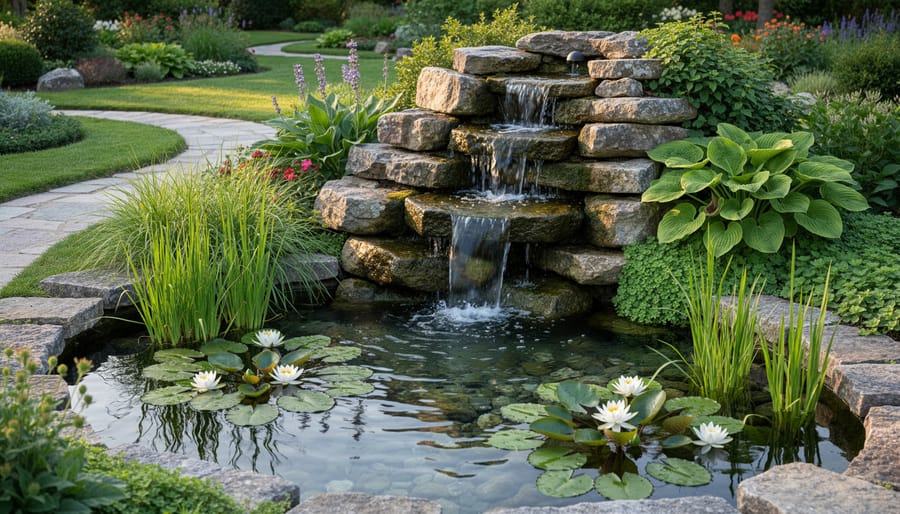
Rock formations make stunning focal points, especially when you stack flat stones or position larger boulders to create gentle cascades. The water naturally finds its path through the crevices, creating that soothing trickling sound we all love. I’ve found that locally sourced rocks help your fountain blend seamlessly into the surrounding landscape, as if Mother Nature placed them there herself.
Bamboo spouts bring an authentic touch of tranquility to any pond. These simple yet elegant features direct water in a single stream, perfect for creating gentle ripples without overwhelming smaller ponds. They’re surprisingly easy to install and maintain, plus they age beautifully as they develop that lovely weathered patina.
Urn fountains offer a more structured organic look. Nestle a terracotta or stone urn among your pond plants, letting water spill gently over the rim. This design works wonderfully for wildlife-friendly gardens because the subtle water movement attracts birds and beneficial insects without creating strong currents that might disturb aquatic creatures. These designs complement naturalistic plantings and provide safe drinking spots for your garden visitors.
Floating and Surface Fountains
If you have a larger pond or lake, floating and surface fountains offer an excellent blend of beauty and practicality. These workhorses sit right on the water’s surface or float freely, creating stunning spray patterns while quietly doing important behind-the-scenes work for your pond’s health.
The magic of these fountains lies in their dual purpose. As water shoots into the air and cascades back down, it adds oxygen to your pond—essential for fish and beneficial bacteria. This aeration helps prevent algae blooms and keeps your water clearer naturally. I’ve seen stagnant ponds transform into vibrant ecosystems within weeks of adding a floating fountain.
From a visual standpoint, you have wonderful options. Classic vertical sprays create elegant columns of water, while tiered patterns produce multiple layers that catch sunlight beautifully. Some models offer interchangeable nozzles, letting you switch between dramatic geysers and delicate fan sprays depending on your mood or the season.
Installation is refreshingly straightforward. Most floating fountains simply need to be placed in water deep enough to keep the motor submerged, typically three to four feet minimum. You’ll run an underwater electrical cable to shore—always use a GFCI outlet for safety. Many units come with mooring lines so your fountain stays positioned where you want it rather than drifting with the wind.
Choosing the Right Fountain for Your Space
Size and Scale Considerations
Getting the size right makes all the difference between a fountain that looks perfectly at home and one that either dominates your pond or gets completely lost in it. I learned this the hard way when I installed a gorgeous tiered fountain in my first backyard pond—it looked stunning in the store but completely overwhelmed my modest 6-foot pond!
Here’s a helpful rule of thumb: your fountain’s height should be no more than half the width of your pond. For example, if you have an 8-foot wide pond, aim for a fountain that’s around 3 to 4 feet tall. This keeps everything visually balanced and prevents the fountain from looking like it’s trying to escape from a too-small home.
The spray width matters too. Ideally, your fountain’s spray radius should reach no more than half the distance to your pond’s edge. This prevents excessive water loss from wind drift and keeps your pump working efficiently. If you have a 10-foot diameter pond, look for fountains with spray patterns that extend about 2 to 3 feet outward.
For smaller ponds under 100 gallons, consider tabletop-style fountains or simple spouting figures. Medium ponds of 100 to 500 gallons can accommodate single-tier fountains with moderate spray patterns. Larger ponds above 500 gallons give you room for dramatic multi-tiered designs or multiple coordinated fountain pieces that create visual interest without crowding.
Matching Your Garden’s Personality
Your fountain choice should feel like a natural extension of your garden’s existing character rather than something dropped in from another world. I learned this the hard way when I first placed a sleek modern fountain in my cottage-style garden—it looked completely out of place!
For cottage gardens bursting with roses and perennials, consider weathered stone or terracotta fountains with gentle curves. These blend beautifully with informal plantings and add that timeless charm. In my own cottage patch, a moss-covered tiered fountain now sits among lavender and daisies, looking like it’s been there forever.
Zen and minimalist spaces call for simple, clean-lined fountains. Think bamboo spouts, single stone basins, or contemporary stainless steel pieces that emphasize water’s natural sound without visual clutter. These work wonderfully for creating focal points in meditation areas.
Formal gardens benefit from symmetrical, classical fountains—think elegant urns or traditional tiered designs that echo the structured layout. Meanwhile, wildlife-friendly gardens do best with shallow basin fountains at ground level where birds and beneficial insects can easily access the water. I’ve watched hedgehogs drink from mine on summer evenings!
Pump Power and Water Flow Requirements
Let’s demystify pump selection so you can focus on creating your beautiful fountain rather than worrying about calculations! Think of GPH (gallons per hour) as simply how much water your pump moves in an hour. A gentle bubbling fountain might only need 50-200 GPH, while a dramatic cascading display could require 500-1000 GPH or more.
Here’s my simple approach: measure your fountain’s height from the water surface to where water exits (that’s your head height). For every foot of height, you’ll lose some pumping power. Most pump packages show a chart matching GPH to head height, making selection straightforward.
Start by asking yourself what water effect you want. A gentle trickle? Choose a smaller GPH. A vigorous spray? Go higher. When I installed my first fountain, I learned this trick: it’s easier to dial down a slightly oversized pump using a flow control valve than to wish you’d gone bigger.
For most artistic fountains under three feet tall, a 200-400 GPH pump works beautifully. Add another 100 GPH for each additional foot of height or if you’re splitting flow between multiple spouts. Remember, you’re not solving complex equations here—you’re simply matching water movement to your creative vision!
Installation Tips That Make the Job Easier
Positioning for Maximum Impact
Where you position your artistic fountain can make or break its impact in your water garden. I learned this the hard way when I first placed a beautiful tiered fountain against my back fence—it looked amazing up close, but completely disappeared when viewed from my patio!
Think about your primary viewing angles. Most of us enjoy our water features from a deck, patio, or favorite garden bench, so position your fountain where it becomes a natural focal point from these spots. If your fountain has intricate details on one side, angle it toward your main seating area. For pieces with 360-degree appeal, consider a central placement where you can appreciate it from multiple angles.
Lighting transforms fountains from daytime beauties into nighttime showstoppers. Position your fountain where you can easily install low-voltage lighting without creating trip hazards. Uplighting creates dramatic shadows, while submersible lights add magical underwater effects.
Consider the backdrop too. Darker plantings or a wooden fence make lighter-colored fountains pop, while dark bronze or stone pieces shine against lighter backgrounds. Leave enough space around your fountain—typically 2-3 feet—for maintenance access and to prevent overhanging plants from clogging the pump.
Safety matters, especially near pond edges. Ensure stable, level ground and keep electrical connections protected and away from water’s edge where children or pets might investigate.
Electrical and Pump Setup Basics
Getting power to your fountain safely is simpler than you might think, though it’s absolutely worth doing right. Always use a GFCI (Ground Fault Circuit Interrupter) outlet for any water feature—this special outlet cuts power instantly if it detects any electrical irregularities, protecting you from shocks. Most outdoor outlets installed in recent years are already GFCI protected, but if yours isn’t, an electrician can swap it out quickly.
For most small to medium fountains, you’ll run a waterproof power cord from your pump to the nearest outdoor outlet. I’ve learned through trial and error that hiding cords along garden edges, beneath mulch, or inside split conduit tubing keeps everything looking polished. Never bury standard extension cords—only direct-burial rated cable should go underground.
The pump itself typically sits submerged in your fountain basin or reservoir, with tubing running up to the fountain head. Size your pump to match your fountain’s height and desired water flow—most manufacturers provide helpful charts.
When should you call an electrician? If you need a new outdoor outlet installed, if you’re working with voltage over 120V, or if you’re simply uncomfortable with electrical work. There’s no shame in hiring a professional for peace of mind—I always do for anything beyond plugging in.
Stabilizing and Securing Your Fountain
A beautiful fountain won’t bring you much joy if it tips over in the first windstorm! Let me share some tried-and-true methods for keeping your artistic centerpiece safe and secure.
For freestanding fountains, weight is your friend. Most quality fountains are heavy enough on their own, but if yours feels tippy, fill the base reservoir completely with water—it adds significant ballast. On flat surfaces like patios, rubber pads underneath prevent sliding and protect your hardscape. I learned this the hard way when my tiered fountain left scratches on my deck!
In-pond fountains need a stable, level base. Use flat stones or concrete pavers to create a solid platform beneath the water. Make sure it’s perfectly level using a carpenter’s level—even slight tilting affects water flow patterns and can strain the pump.
For floating fountains, the tethering system matters tremendously. Use marine-grade rope or coated cable anchored to heavy objects on the pond bottom—concrete blocks work wonderfully. Attach at three or four points to prevent spinning and drifting. In windy areas, consider adding extra anchors. The substrate beneath should be firm; avoid silty bottoms where anchors might shift over time. Regular checks ensure everything stays put through seasonal changes.
Creating Artistic Harmony with Plants and Lighting
Plant Pairings That Enhance Water Features
The plants you choose around your fountain can make the difference between “nice” and “absolutely stunning!” I learned this after placing my first fountain in a bare spot—it looked lonely until I surrounded it with the right greenery.
Start with height variation to guide the eye. Place taller plants like papyrus or dwarf cattails at the back or sides of your fountain, then graduate down to medium-height options like pickerel rush or iris. This creates a natural frame that draws attention to your fountain’s centerpiece. Around the base, low-growing creepers like creeping jenny spill beautifully over edges.
Color coordination works wonders too. If your fountain has warm copper or bronze tones, pair it with golden-hued plants like yellow flag iris or orange cannas. Cool-toned stone fountains look magical with purple lobelia, blue water forget-me-nots, or white peace lilies.
One of my favorite combinations includes purple Louisiana iris for height, variegated sweet flag for mid-level interest, and bright green parrot’s feather trailing into the water. The contrast creates movement that complements the fountain’s flow perfectly.
Remember that marginal plants (those growing in shallow water at the edges) soften hard fountain edges naturally, while floating plants like water lettuce add another dimension without competing for attention.
Illuminating Your Fountain After Dark
There’s something absolutely magical about watching water dance in the glow of evening light! When the sun sets, proper lighting transforms your fountain from a daytime feature into a captivating nighttime centerpiece that extends your outdoor enjoyment well into the evening.
Let’s start with the basics. You have three main lighting options: submersible underwater lights, spotlights positioned around the fountain, and LED strips. Underwater lights create that enchanting glow-from-within effect, making the water itself seem luminous. I particularly love how they highlight bubbles and spray patterns. Spotlights, placed at the fountain’s base or nearby, cast dramatic shadows and emphasize sculptural elements. LED strips offer flexibility for outlining fountain edges or bowls.
Here’s the exciting part about modern LED technology: you’ll slash your energy bills while gaining incredible versatility. Many LED fixtures use less than 10 watts while producing brilliant illumination. Look for solar-powered options if you want to eliminate electrical costs entirely, though they work best in consistently sunny locations.
Color temperature matters more than you might think. Warm white (2700-3000K) creates cozy, inviting ambiance perfect for relaxation areas. Cool white (5000-6500K) produces crisp, dramatic effects that highlight architectural details. Many homeowners start with warm white, then experiment with colored bulbs for special occasions. Multicolor LED systems with remote controls let you shift moods instantly, from serene blues to festive celebrations.

Keeping Your Artistic Fountain Running Beautifully
Routine Cleaning and Algae Management
Keeping your artistic fountain sparkling clean doesn’t have to feel like a chore! I’ve learned that consistency is your best friend here. Set yourself a monthly cleaning date—I mark mine on the calendar right next to my birthday so I never forget.
For monthly maintenance, drain your fountain and give it a gentle scrub with a soft brush and plain water. Avoid harsh chemicals that can damage decorative finishes or harm any plants nearby. For stubborn mineral deposits on stone or concrete, white vinegar works wonders. Just apply it with a soft cloth, let it sit for ten minutes, then rinse thoroughly. If you have a metal fountain, stick with mild soap and water to preserve the patina.
Algae loves sunshine and still water, but you can outsmart it naturally. Add a fountain pump to keep water moving—algae struggles in circulation. Consider placing a few barley straw pellets in your basin; they release natural compounds that discourage algae without chemicals. During peak summer months, you might need to clean every two to three weeks instead of monthly.
Seasonal deep cleaning is essential too. Before winter, drain completely and protect delicate finishes. Come spring, scrub everything fresh and check all components before refilling. Trust me, this rhythm becomes second nature quickly!
Winterizing and Seasonal Care
When temperatures drop below freezing, your beautiful fountain needs special attention to survive winter intact. The general rule? If your climate consistently dips below 32°F, you’ll want to shut down and winterize your fountain to prevent costly freeze damage.
Start your winterizing process before the first hard freeze arrives. Drain all water completely from the fountain, pump, tubing, and basin. This is crucial because any remaining water will expand when frozen, cracking ceramic, concrete, or resin components. I learned this lesson the hard way with my first fountain, and trust me, spring repairs aren’t fun!
Remove your pump and store it indoors, submerged in a bucket of water in your basement or garage. This keeps internal seals from drying out and cracking. Clean it thoroughly first to prevent algae buildup during storage.
For fountains you can’t easily drain completely, use a fountain de-icer or small pond heater to keep water circulating in mild winter areas. This works well if you only experience occasional freezing nights.
Cover your fountain with a breathable, weatherproof fountain cover to protect finishes from ice, snow, and debris. Avoid plastic tarps that trap moisture. For smaller pieces, bring decorative elements indoors until spring returns.
Your water garden is more than just a beautiful outdoor feature—it’s your personal retreat, a place where the stresses of the day simply melt away. Adding an artistic water fountain transforms that space from lovely to extraordinary, creating a sanctuary that speaks to your unique style and brings you genuine joy every time you step outside.
The beauty of choosing a fountain for your water garden is that there’s no single right answer. Maybe you’ll start with a simple bubbling rock that fits perfectly in your small pond, or perhaps you’re ready to dive in with an elaborate tiered fountain as your backyard centerpiece. What matters most is that it feels right for your space, your budget, and your vision. I’ve seen countless water gardeners begin with modest setups and gradually expand as their confidence grows—and that’s a perfectly wonderful approach.
Remember, the perfect fountain isn’t necessarily the most expensive or elaborate one. It’s the fountain that makes you smile when you hear its gentle splash, the one that catches the morning light just so, or the one that finally gives your pond that finishing touch you’d been imagining. Trust your instincts, start where you’re comfortable, and don’t be afraid to experiment.
Your fountain journey begins with a single step—whether that’s browsing design options, measuring your space, or simply dreaming about the possibilities. The sanctuary you’ve been envisioning is closer than you think. Why not start today?