How the Four Types of Biodiversity Keep Your Pond Alive and Thriving

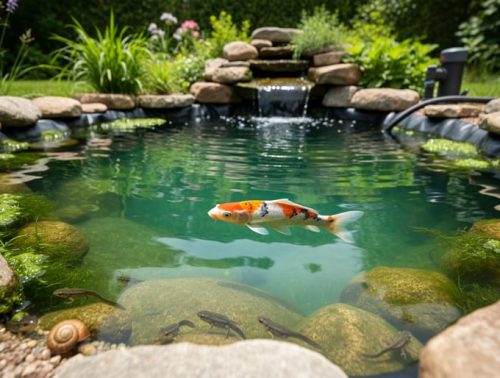
Stand at the edge of your pond right now and count what you see: fish swimming, dragonflies hovering, plants swaying, maybe a frog hiding among the lily pads. Each living thing you’ve spotted represents one piece of a complex puzzle that determines whether your water garden thrives or struggles. Your pond’s biodiversity isn’t just about having lots of different creatures—it’s about understanding how four specific components work together to create a self-sustaining ecosystem that …

Read more How the Four Types of Biodiversity Keep Your Pond Alive and Thriving

Set It and Forget It: Your Pond’s Self-Maintaining Water Change System

Transform your pond maintenance routine from a weekly chore into a completely hands-free operation by installing a simple automatic water change system that works while you sleep. Picture this: crystal-clear water, healthy fish, and thriving plants without ever hauling another bucket or wrestling with hoses on Saturday mornings.
Your pond loses water daily through evaporation and fish waste constantly builds up harmful compounds, creating a maintenance treadmill that never stops. An automatic system solves both problems simultaneously by adding fresh water on a timer while removing old water through an overflow drain, exactly like …

Read more Set It and Forget It: Your Pond’s Self-Maintaining Water Change System

Why Your Pond Needs Living Filters (And How They Actually Work)

Your pond water looks murky, your fish are gasping at the surface, and you’re wondering why that expensive filter isn’t doing its job. The answer might surprise you: mechanical filtration alone won’t keep your pond healthy. You need an invisible army of beneficial bacteria working around the clock to break down fish waste, uneaten food, and decaying plant matter before they poison your water.
Biological filtration is nature’s own cleanup crew. Think of it as a miniature wastewater treatment plant right in your backyard. Beneficial bacteria colonize special filter media, converting toxic ammonia from fish …

Read more Why Your Pond Needs Living Filters (And How They Actually Work)

Why Your Pond’s Water Level Matters More Than You Think

Check your pond’s water level weekly by marking a fixed reference point on a stake or rock at the waterline. Consistent monitoring reveals whether you’re losing inches to evaporation, leaks, or excessive outflow before small issues become expensive problems.
Control water flow by installing a simple standpipe or adjustable weir at your pond’s outlet. This lets you set your desired water level and maintain it automatically, preventing both overflow during heavy rains and excessive drawdown during dry spells.
Identify leak locations by letting your pond drop naturally and watching where the water level …

Read more Why Your Pond’s Water Level Matters More Than You Think

Why D.E. Filters Keep Your Pond Crystal Clear (Without Harsh Chemicals)

Consider diatomaceous earth filtration if you’re dreaming of crystal-clear pond water that looks like glass. This natural filtration method uses microscopic fossilized algae to trap particles as tiny as 3-5 microns, making it roughly three times more effective than traditional sand filters. Think of D.E. filters as the precision tools of pond keeping—they capture everything from free-floating algae cells to the finest debris that clouds your view of those gorgeous koi.
D.E. filters work by coating grids inside a pressure tank with diatomaceous earth powder, creating a filter bed that water passes through. As your pump pushes…

Read more Why D.E. Filters Keep Your Pond Crystal Clear (Without Harsh Chemicals)

Why Your Backyard Pond Needs the Same Care as a Natural Lake

Your pond is struggling because you’ve been fighting individual problems instead of supporting the whole system. Ecosystem-based management means working with nature’s interconnected web rather than against it, and it’s the difference between constantly battling algae blooms and enjoying a balanced, self-sustaining water feature.
Think of your pond like a neighborhood. You wouldn’t try to fix community problems by only focusing on one house while ignoring how residents interact with each other. Similarly, you can’t create lasting pond health by just treating symptoms like murky water or invasive plants…

Read more Why Your Backyard Pond Needs the Same Care as a Natural Lake

The Filter Media Your Pond Actually Needs (Not What Big Brands Push)

Choose mechanical media like foam pads or filter brushes as your first line of defense—they trap visible debris before it clogs your biological media, and you’ll clean them every 1-2 weeks during peak season. Layer biological media such as ceramic rings or bio-balls in the chamber after mechanical filtration, creating maximum surface area where beneficial bacteria colonize to convert harmful ammonia into safer nitrates. Add activated carbon or zeolite as chemical media when you’re battling algae blooms, medication residue, or persistent odors, but replace them monthly since they become saturated and stop working.
Your …

Read more The Filter Media Your Pond Actually Needs (Not What Big Brands Push)

Why Your Koi Pond Needs a Biological Filter (And How to Make It Work)

Install a biological filter before adding koi to your pond—it’s the single most important investment you’ll make in keeping your fish healthy and your water crystal clear. Think of it as hiring a microscopic cleaning crew that works 24/7, converting toxic fish waste into harmless compounds through the nitrogen cycle.
Your pond naturally produces ammonia from fish waste, uneaten food, and decaying plant matter. Without biological filtration, this ammonia quickly reaches lethal levels. A properly functioning biological filter houses beneficial bacteria that first convert ammonia into nitrite, then nitrite into nitrate—…

Read more Why Your Koi Pond Needs a Biological Filter (And How to Make It Work)

The Hidden Chemistry Making Your Pond Fish Sick (And How to Fix It)

Your pond looks crystal clear, your fish seem healthy, yet something feels *off*—maybe the koi aren’t as vibrant as they should be, or that stubborn algae bloom keeps returning no matter what you do. The culprit might be invisible to the naked eye: trace elements, those microscopic minerals present in such tiny amounts that standard test kits miss them completely, yet they’re absolutely critical to your pond’s ecosystem balance.
I learned this the hard way three years ago when my beloved water lilies stopped blooming despite perfect pH and ammonia levels. After months of frustration, a trace element test revealed…

Read more The Hidden Chemistry Making Your Pond Fish Sick (And How to Fix It)

Protect Your Pond: How Invasive Species Can Destroy Your Water Garden

Inspect your pond weekly for unusual plant growth patterns, odd-colored algae, or unfamiliar floating vegetation – these are the earliest warning signs of invasive species taking hold. Install protective barriers around pond edges and filter all incoming water sources to protect your water garden from unwanted invaders. Remove any suspicious plants immediately, including their complete root systems, and dispose of them in sealed bags away from water sources. The impact of invasive species extends far…

Read more Protect Your Pond: How Invasive Species Can Destroy Your Water Garden