
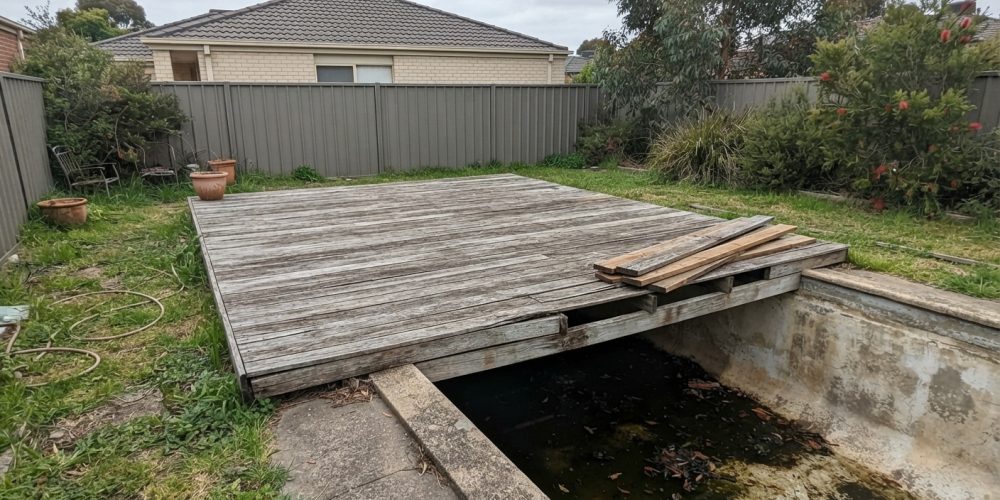
Pool Removal vs. Covering It Over: Why the Shortcut Costs More Later
A drained, forgotten backyard pool tends to attract the same idea sooner or later. Why not just build a deck over it? Or tip a few loads of soil in, roll some turf on top, and call it done? It looks finished within a weekend, and the quote comes in at a fraction of what a proper removal crew would charge.
The trouble shows up later. Usually a year or two later, and usually at the worst possible time.
Decking over the hole doesn’t make it go away
Decking over an empty pool is popular because nothing has to be broken up or carted off. The shell stays put, a frame goes on top, and the yard gains an entertaining area almost overnight.
What sits underneath doesn’t stay quiet. An empty concrete or fibreglass shell collects rainwater with nowhere to drain, so the space under the boards slowly turns into a stagnant tank. Mosquitoes find it fast. Timber bearers sitting over standing water rot from below, and nobody sees it happening until a board gives way underfoot.
Then there’s the paperwork. In Victoria, anything capable of holding more than 30cm of water counts as a pool or spa for registration purposes. A covered shell can still tick that box, so the barrier rules and four-yearly safety inspections may still apply to something you thought was gone. Councils generally want evidence a pool has been properly decommissioned before they’ll take it off the register.
Filling it in without a plan
Backfilling is a legitimate method. Partial removal, where the base is broken to allow drainage and the shell is filled and compacted, gets done properly all the time. The shortcut version is something else: a few truckloads of whatever soil is cheapest, dumped in and levelled by eye.
Loose fill settles. Water works through it after every heavy rain, and the ground drops unevenly over the following months. A lawn starts to dip in the middle. Pavers lift at one end and sink at the other. Anyone who has tried to put a shed or a granny flat over a badly filled pool learns quickly that the slab won’t sit right until the fill is dug out and redone, and that second job costs more than doing it correctly would have.
Done properly, clean fill goes in and gets compacted in layers, with the base broken so water can escape instead of collecting inside the old shell. It takes longer. It’s also the only version a builder will happily put footings on.
Selling is usually when it catches up with you
A buyer’s building inspector will spot a deck with oddly familiar proportions, or a patch of lawn sitting lower than everything around it, and start asking questions. Without permits or compaction records, you’re left explaining a buried pool with nothing to back it up. Some buyers walk away, and the ones who stay tend to knock their offer down to cover the risk, sometimes by more than the job would have cost in the first place.
A few other ways the cheap option bites back:
- Insurance claims can get messy when an undeclared structure sits under a collapsed deck
- Renovation plans stall because a builder can’t sign off on footings over unknown fill
- Council picks it up at a later inspection, and you end up doing the job properly anyway, just on someone else’s timeline
None of this is unusual. It’s what happens when a hole in the ground never actually gets dealt with.
Paying once or paying twice
Covering a pool feels easier because the upfront number is smaller. That’s understandable. But the honest comparison isn’t removal against a deck. It’s removal now against removal later, plus the deck, plus whatever damage built up underneath in the meantime. Looked at that way, the pool removal cost stops being the scary figure in the equation and starts looking like the cheaper of the two paths.
Full removal leaves nothing underground at all. Even a partial removal, done with the base broken and the fill compacted in stages, leaves a stable, documented result. Either way, council can take it off the pool register, and you’ve got a straight answer ready when an insurer or a buyer asks what happened to the pool.
Getting it right before anything goes on top
The best time to decide is before timber, turf or pavers go down, because every fix after that starts with pulling them back up. If an unused pool is sitting in your yard right now, get a quote from a specialist removal team before committing to any cover-up job, and ask them to walk you through what full and partial removal would each look like on your site.