
Is Pond Water a Compound? Understanding What’s Really in Your Pond
No, pond water is not a compound. It’s a mixture of water molecules, dissolved minerals, organic matter, microscopic organisms, and suspended particles that can all be separated through physical means.
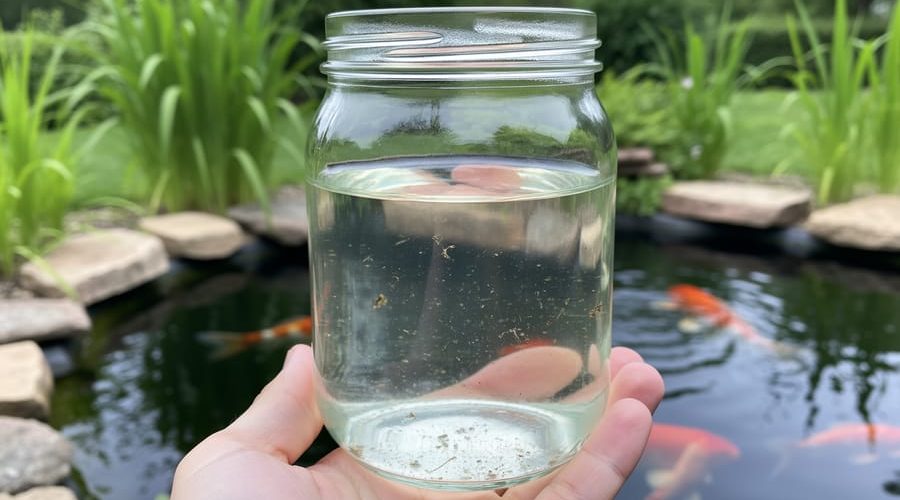
If you’ve ever scooped a jar of water from your pond and held it up to the light, you’ve probably noticed it’s not crystal clear like distilled water from a lab. That cloudiness tells an important story about chemistry. Understanding whether pond water is a compound or mixture matters more than you might think, especially when you’re trying to maintain a healthy ecosystem for fish and plants or troubleshooting water quality problems.
The distinction between compounds and mixtures is fundamental chemistry, but it has real consequences for how you manage your pond. A compound like pure H₂O has a fixed composition and requires chemical reactions to break apart. A mixture can be separated by filtering, settling, or evaporation, which is exactly what happens in your pond naturally and what you replicate when you clean your filter or add treatments.
In this guide, we’ll break down what makes pond water a mixture rather than a compound, explore the components you’ll actually find swimming around in there, and show you how this knowledge helps you make better decisions about water testing, filtration, and keeping your pond balanced throughout the year. Whether you’re puzzling over a homework question or trying to understand why your pond behaves the way it does, you’ll walk away with a clear answer and practical insights you can use right away.
What Pond Water Actually Is: Mixture vs. Compound
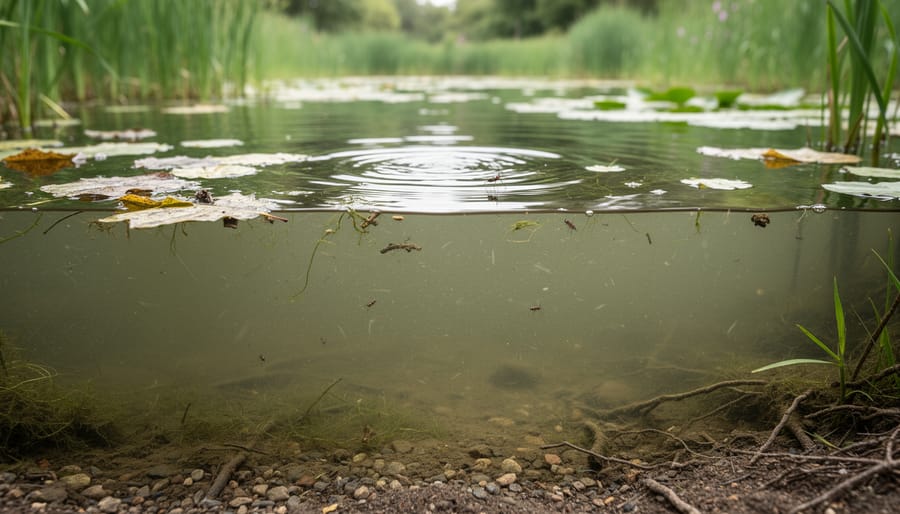
Pond water is a mixture, not a compound. That simple distinction explains why your pond’s water can change from crystal clear to murky green, why fish can thrive in it despite its complexity, and why you can adjust specific aspects without starting from scratch.
A compound is a substance formed when two or more elements chemically bond together in fixed, unchanging proportions. Water itself, H2O, is a compound: two hydrogen atoms bonded to one oxygen atom in every single molecule. Break those bonds and you no longer have water. The ratio never varies.
A mixture, by contrast, combines multiple substances that keep their individual identities. The components aren’t chemically bonded together, so they retain their separate properties and can exist in varying amounts. Your pond water contains water molecules (the compound H2O), dissolved minerals, organic matter, gases, living organisms, and countless other substances all mingling together, but none of them are chemically locked into fixed ratios.
Think of it this way: if you scoop water from the shallow end of your pond and compare it to water from near the bottom, you’ll find different concentrations of sediment, oxygen, and nutrients. That variability proves it’s a mixture. A compound would have identical composition everywhere.
- Compound
- A substance formed when elements chemically bond in fixed ratios, like H2O (water) or NaCl (table salt). You cannot separate the components without breaking chemical bonds.
- Mixture
- A combination of substances that retain their individual properties and aren’t chemically bonded, like pond water containing minerals, organisms, and dissolved gases. The proportions can vary.
- Solution
- A mixture where one substance dissolves completely in another, such as minerals dissolved in your pond water. The dissolved particles are too small to see.
- Suspension
- A mixture with larger particles that don’t dissolve but float throughout the liquid, like algae or sediment in cloudy pond water. These particles eventually settle if the water sits undisturbed.
- Colloid
- A mixture with particles smaller than suspensions but larger than solutions, such as dissolved organic matter that creates the slightly cloudy appearance in established ponds. The particles remain dispersed and don’t settle out.
Understanding pond water as mixtures not chemically bonded explains why you can remove algae with beneficial bacteria, adjust pH with buffers, or reduce ammonia levels, you’re changing specific components without altering the fundamental water structure. The mixture nature of pond water makes it manageable rather than mysterious.
What’s Swimming Around in Your Pond Water
Dissolved vs. Suspended: How Substances Exist in Water
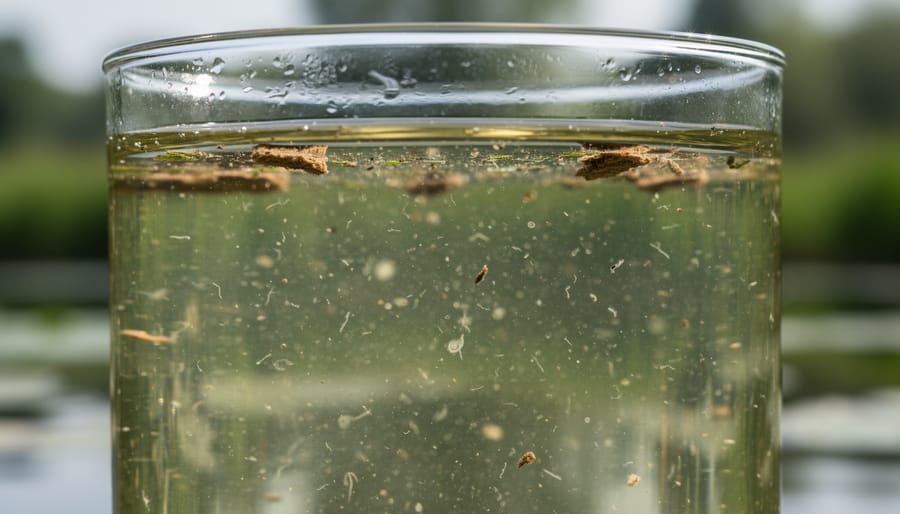
When you look at your pond water, you’re seeing the result of two fundamentally different ways substances exist in the mix. Some materials dissolve completely, breaking down into individual molecules or ions that become part of the water itself. Think of salt disappearing into water: it’s still there, but you can’t see it. That’s what happens with minerals like calcium, magnesium, and nitrates in your pond. These dissolved substances flow right through filter media because they’re molecularly tiny.
Suspended particles work differently. They float or drift through the water without actually becoming part of it, like dust motes in a sunbeam. Algae cells, dirt particles, fish waste, and decaying plant matter all fall into this category. These are the culprits behind cloudy or green water. Unlike dissolved substances, suspended particles are large enough that mechanical filters can trap them, and they’ll eventually settle to the bottom if the water stays still long enough.
This distinction matters tremendously for maintenance. When your pond looks murky, you’re dealing with suspended particles, filtration and UV clarifiers help. But when test strips show high nitrate levels while the water looks crystal clear, that’s dissolved material at work. You can’t see it or filter it out mechanically. Different problems require different solutions, and knowing which category you’re tackling saves you time, money, and frustration. Clear water doesn’t always mean balanced water.
How Pond Water Chemistry Works
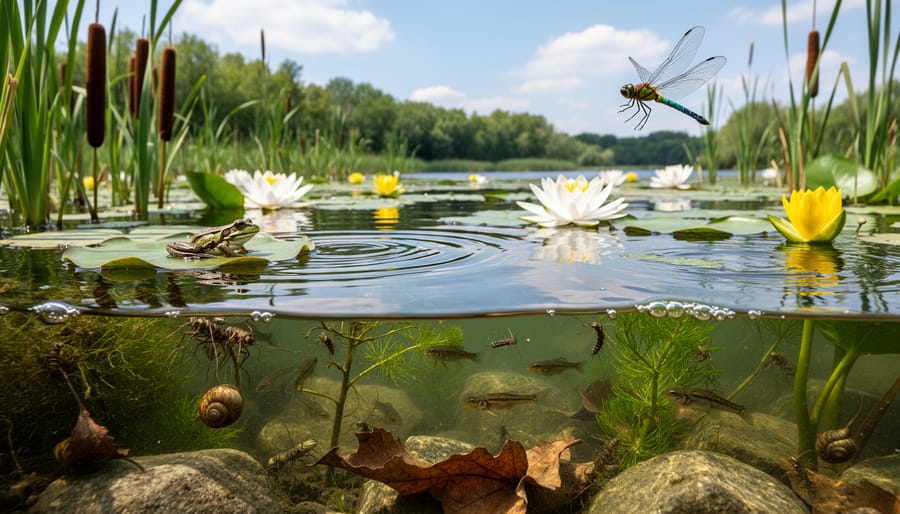
Pond water doesn’t sit still. Its components shift constantly through natural cycles and interactions that transform the mixture from moment to moment. Fish waste breaks down, plants absorb nutrients, bacteria convert compounds, and weather adds or removes substances, all without changing water’s basic H2O structure.
The nitrogen cycle drives much of this chemical activity. When fish excrete waste or organic matter decays, it releases ammonia into the water. Beneficial bacteria in your pond then convert this toxic substance through a progression from ammonia to nitrite to nitrate with each stage handled by different bacterial colonies. Nitrate, the final product, becomes fertilizer for aquatic plants. This continuous transformation means the nitrogen content in your pond constantly fluctuates based on fish load, feeding rates, plant growth, and bacterial populations.
pH levels also change throughout the day and across seasons. During daylight hours, plants and algae consume carbon dioxide through photosynthesis, which raises pH. At night, respiration releases CO2 back into the water, lowering pH again. Rainfall can drop pH suddenly because rain tends toward acidity, while hard water with dissolved limestone gradually raises it. These shifts affect how toxic ammonia behaves, higher pH makes it more harmful to fish even at the same concentration.
Mineral balance changes too. Calcium and magnesium dissolve from rocks and substrate, building up over time and increasing water hardness. Evaporation concentrates these minerals because water escapes but dissolved solids stay behind, which explains why topped-up ponds gradually become harder than newly filled ones. Plants pull potassium, iron, and trace elements from the water for growth, sometimes creating deficiencies that limit algae control.
Temperature affects everything. Warmer water holds less dissolved oxygen but speeds up bacterial activity and fish metabolism, creating a cascade where oxygen demand increases just as supply decreases. Cold water slows the nitrogen cycle dramatically, allowing ammonia to accumulate if you keep feeding fish at winter rates. The mixture remains water, but its behavior and chemistry transform with every degree of temperature change.
Why This Science Matters for Your Pond
Testing and Adjusting Your Water Balance
Because pond water is a mixture rather than a locked-in compound, you can test and adjust individual components without disrupting the whole system. Think of it like tuning instruments in an orchestra, you can adjust one without retuning everything else.
Start with a quality pond water testing kit that measures pH, ammonia, nitrite, nitrate, and dissolved oxygen. Test weekly during warm months when biological activity peaks, and every two weeks in cooler periods.
When you get your results, look for patterns rather than perfect numbers. A pH between 6.5 and 8.5 works for most ponds, but stability matters more than hitting an exact target. If ammonia or nitrite levels spike, it signals the nitrogen cycle needs support, add beneficial bacteria rather than reaching for harsh chemicals.
High nitrates suggest excess organic matter. Remove decaying leaves, cut back on feeding, and consider adding more plants to absorb nutrients naturally. Low oxygen readings mean you need better aeration, especially overnight when plants stop producing oxygen.
The beauty of understanding pond water balance as a mixture is recognizing you’re working with adjustable components. You’re not trying to create a new chemical formula, you’re simply bringing the existing mix into harmony. Small, gradual changes work better than dramatic interventions. Adjust one parameter, wait a few days, then retest before making another change. This patient approach prevents shocking your fish and plants while moving steadily toward clear, healthy water.
Common Questions About Pond Water Composition
Can pond water ever become a compound?
No, pond water can’t become a compound because it will always contain multiple substances mixed together rather than chemically bonded elements. Even if you could remove every impurity, you’d be left with pure H2O (water itself, which is a compound), but natural pond water will always have dissolved minerals, gases, and organic matter.
What happens to pond water when I add treatment chemicals?
When you add treatments like dechlorinators or pH adjusters, you’re simply introducing new substances into the mixture. These chemicals interact with existing components, neutralizing chlorine, buffering pH, or breaking down organic matter, but the water remains a mixture with added or altered ingredients.
Is tap water different from pond water?
Both are mixtures, but tap water typically contains fewer organic materials and has added chlorine or chloramine for disinfection. Pond water contains more biological components like algae, bacteria, fish waste, and decomposing plant material, making it a much more complex and variable mixture.
Can I use distilled water in my pond?
While distilled water is the closest to pure H2O, it’s not ideal for ponds because it lacks the beneficial minerals fish and plants need. You’d need to remineralize it anyway, turning it back into a mixture similar to natural pond water.
Why does my pond water change color and smell?
Color and odor changes reflect shifts in the mixture’s composition. Green water usually means suspended algae, brown indicates tannins from decomposing leaves, and foul smells signal excess organic matter breaking down without enough oxygen. These are all signs that the balance of components in your mixture needs adjustment, often related to algae problems or nutrient overload.
Understanding these common questions helps you realize that managing pond water means managing a dynamic mixture. You’re not trying to create a single, stable compound but rather maintaining a healthy balance among dozens of interacting components. Each adjustment you make changes the mixture’s composition slightly, which is exactly why regular testing and observation matter so much for keeping your water garden thriving.
Now you understand the fundamental truth: pond water isn’t a compound, it’s a dynamic mixture of countless substances working together in your backyard ecosystem. This distinction isn’t just chemistry trivia. It’s the key to successful pond management.
Because pond water is a mixture, you have real power to shape its composition. You can target specific problems without disrupting everything else. Need to reduce algae? Adjust nutrients. Fish gasping? Increase oxygen. Water cloudy? Address suspended particles. Each component can be modified independently because they’re not locked together in fixed chemical bonds.
Your pond’s water chemistry changes with every rainfall, every fish feeding, every plant growing. That’s normal for a mixture. Regular testing helps you track these shifts and respond before small imbalances become big headaches.
Armed with this knowledge, you’re no longer just maintaining a pond, you’re managing a living mixture. Test regularly, adjust thoughtfully, and remember that understanding what’s actually in your water is the first step toward creating the thriving water garden you envision. Your pond’s chemistry is in your hands.