
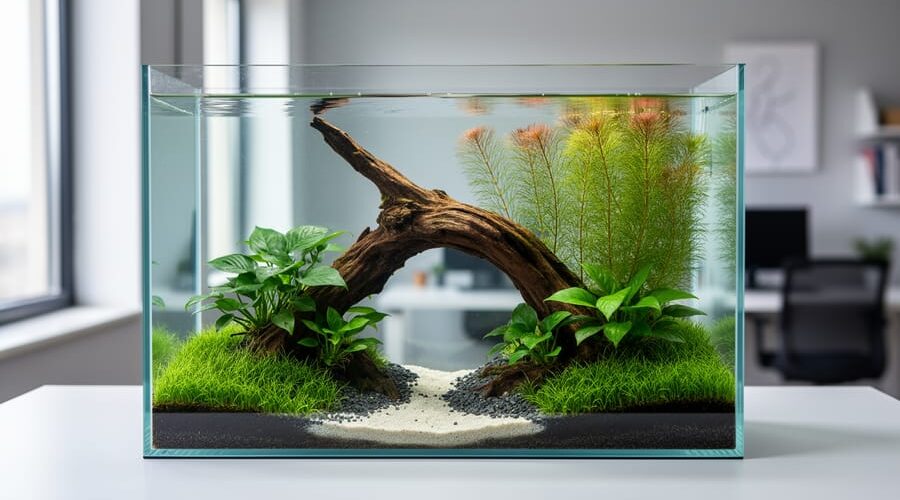
Transform Any 5-Gallon Tank Into a Living Underwater Masterpiece
Transform a humble 5-gallon tank into a breathtaking underwater landscape by choosing a clear focal point—a striking piece of driftwood, a dramatic rock formation, or a single statement plant like a vibrant red lotus or cascading Amazon sword. Position this centerpiece using the rule of thirds, placing it off-center rather than dead middle to create natural visual flow that draws the eye through your miniature aquatic world.
Layer your substrate strategically to add depth and dimension. Slope your gravel or sand from back to front, creating hills that rise 3-4 inches at the rear and taper to barely an inch up front. This simple technique makes your 5-gallon tank appear substantially deeper and provides varied planting zones for different root depths.
Select plants with purpose and proportion in mind. In small tanks, every plant matters—choose low-growing carpeting species like dwarf hairgrass for the foreground, mid-sized Java fern or Anubias nana for the middle ground, and a single taller background plant like rotala or water wisteria to complete your layered look. The same expert aquascaping principles that create stunning outdoor ponds apply equally to desktop tanks—it’s all about creating natural-looking scenes that feel balanced and alive.
Remember that small aquascapes serve as perfect testing grounds for techniques you might later apply to larger ponds. The skills you develop arranging hardscape, selecting complementary plant textures, and managing scale translate directly to outdoor water features, making your 5-gallon tank both a beautiful display and a valuable learning laboratory.
Why 5-Gallon Tanks Are Perfect for Learning Aquascape Design
Starting with a 5-gallon aquascape is like learning to paint on a small canvas before tackling a mural. It’s the perfect training ground for anyone who dreams of designing larger water features or simply wants to master the art of aquascaping without overwhelming themselves.
The beauty of working small is that you can see results quickly. While a large pond might take weeks to establish and months to perfect, a 5-gallon tank can be set up in an afternoon and begin showing its full personality within days. This instant gratification keeps you motivated and lets you experiment with different arrangements until you discover what works.
Let’s talk about your wallet too. Starting small means you’ll spend considerably less on substrate, plants, hardscape materials, and equipment. If something doesn’t work out the way you envisioned, you’re not looking at a major financial setback. You can easily redesign or start fresh without the commitment that larger projects demand.
Here’s something I love about 5-gallon systems: they’re incredible teaching tools for understanding ecosystem dynamics. Every element in a small aquascape has an amplified impact. You’ll quickly learn how plant growth affects water quality, how light duration influences algae, and how different substrates support root development. These lessons translate directly to larger pond designs, giving you confidence and expertise that would take much longer to develop otherwise.
Maintenance is wonderfully manageable too. A complete water change takes minutes, not hours. Trimming plants and repositioning elements happens in a single sitting. This accessibility means you’ll actually enjoy the upkeep rather than viewing it as a chore, and that hands-on time deepens your understanding of how aquatic ecosystems function and thrive.
The Building Blocks: Understanding Aquascape Elements in Miniature
Substrate Selection and Layering
Getting your substrate right is like creating the foundation of a house—it sets everything up for success! In a 5 gallon tank, you’re working with limited depth, so every layer counts.
I recommend using about 1 to 2 inches of substrate total. Go thinner in the front (maybe just half an inch) and gradually build to 2 inches toward the back. This sloping technique is your secret weapon for creating the illusion of depth, making your tiny tank look surprisingly spacious. It’s the same principle I use when designing shallow pond edges that seem to stretch forever!
For planted aquascapes, start with a nutrient-rich base layer like aquarium soil or clay pellets. Top this with fine gravel or sand in natural earth tones—blacks, browns, and grays work beautifully. Avoid bright colors that scream “fake aquarium” and instead aim for that natural streambed look.
Here’s a fun trick: place a few larger stones or pieces of driftwood strategically before adding your top substrate layer. Then nestle the substrate around them. This creates a more integrated, natural appearance, as if those hardscape elements have been there forever, slowly settling into the riverbed.
Hardscape Materials That Work in Small Spaces
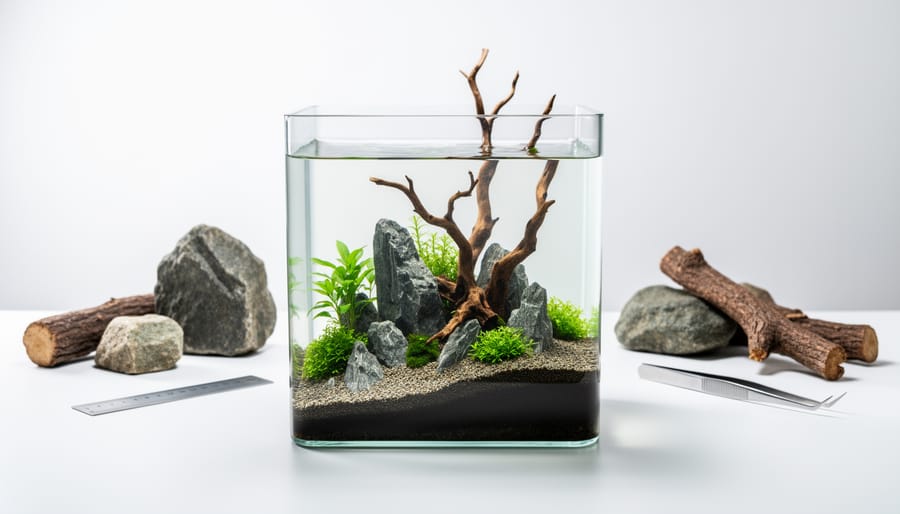
Choosing the right hardscape for your 5-gallon tank is like selecting stones for a small garden pond – scale matters tremendously! I learned this the hard way when I enthusiastically crammed a gorgeous piece of driftwood into my first tiny tank, only to realize it dominated the entire space and left no room for plants or fish to swim.
For small aquascapes, think thumbnail-sized rocks rather than fist-sized boulders. Dragon stone, seiryu stone, and small lava rocks work beautifully because their intricate textures create visual interest without overwhelming the space. A single palm-sized rock can serve as your focal point, with a few pebbles arranged around it for depth.
Driftwood pieces should be slender and branching rather than thick and chunky. Look for twigs and small branches from Malaysian or Manzanita driftwood that create airy structures. These natural hardscape materials add dimension without eating up precious swimming space.
A helpful rule: your largest hardscape piece should be no more than one-third of your tank’s height. This proportion creates balance and leaves room for the living elements that bring your aquascape to life. Remember, in small spaces, less is definitely more – embrace negative space as part of your design.
Plant Selection for Scale and Balance
Choosing the right plants makes all the difference in a 5 gallon setup. You want species that stay compact and grow slowly, giving you time to enjoy your design without constant trimming. For the foreground, dwarf hairgrass or monte carlo create beautiful carpets without overwhelming the space. I learned this the hard way when I once planted regular java fern in a small tank and watched it take over within weeks!
Mid-ground plants like anubias nana petite and bucephalandra varieties add texture while staying manageable. These attach to hardscape, saving precious substrate space. For background interest without the height, consider using stem plants like rotala rotundifolia, which you can easily trim to maintain scale.
Creating visual hierarchy means placing shorter plants in front and gradually increasing height toward the back. This simple layering trick makes even a tiny aquascape feel spacious and intentional. Think of it like arranging flowers in a vase, each element complementing the others without competing for attention.
Five Stunning 5-Gallon Aquascape Ideas You Can Build This Weekend
The Mountain Valley: Creating Depth with Iwagumi Principles
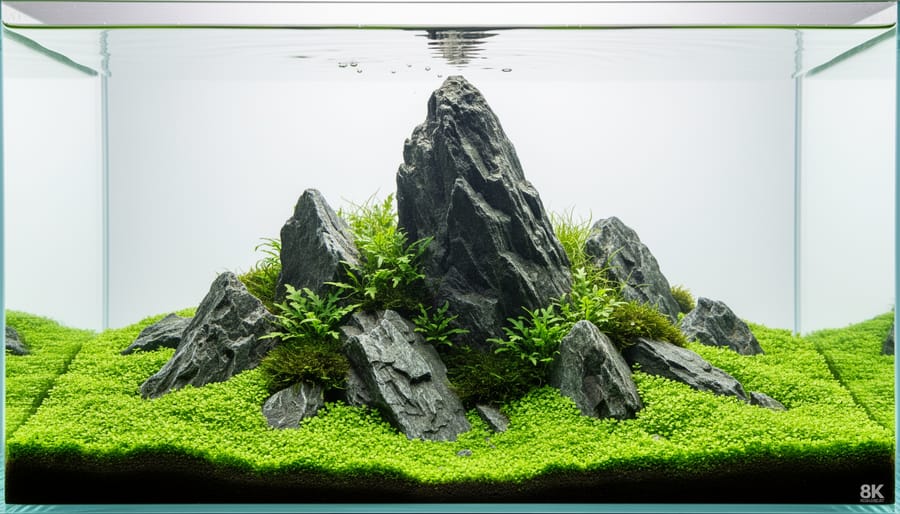
The Iwagumi style brings centuries-old Japanese-inspired design principles into your 5-gallon tank, creating stunning depth through strategic stone placement. I absolutely love this approach because it proves that minimalism doesn’t mean boring—it means intentional.
Start by selecting three to five stones of varying sizes. Your largest stone, called the Oyaishi or parent stone, becomes your focal point. Position it slightly off-center, about one-third from the left or right side of your tank. This follows the golden ratio, which naturally pleases the eye. Place your second-largest stone, the Fukuishi, nearby to create a supportive relationship. Add smaller accent stones to complete the composition, always using odd numbers.
For substrate, slope fine aquarium sand or soil from back to front, rising at least 2-3 inches at the rear. This slope amplifies the sense of depth dramatically. Plant low-growing carpeting plants like dwarf hairgrass or Monte Carlo between the stones. The key is restraint—leave open spaces that allow the stones to breathe.
The beauty of practicing Iwagumi in a 5-gallon tank is that you can master these techniques before applying them to larger ponds or water features. I started my first Iwagumi layout in a tiny tank on my desk, and those lessons directly translated when I designed my backyard pond. The principles scale beautifully, and the meditative process of arranging stones is genuinely therapeutic.
The Enchanted Forest: Vertical Landscapes in Compact Spaces
Think of your 5-gallon aquarium as a magical window into a miniature woodland realm. The Enchanted Forest design takes advantage of vertical space, which is especially clever when you’re working with limited square footage. I discovered this approach after struggling to fit all my favorite plants into a small tank, and it completely changed how I think about compact aquascaping.
Start with a tall piece of driftwood as your centerpiece. Spider wood or manzanita branches work beautifully because they naturally grow upward with interesting twists and angles. Position your wood so it reaches at least two-thirds of the way up your tank, creating that dramatic forest canopy feel. Secure the base with small stones or bury it slightly in your substrate.
Now comes the fun part – choosing your climbing and draping plants. Anubias nana can be attached to the middle sections of your wood using fishing line or aquarium-safe glue. Java fern works wonderfully higher up, as its roots don’t need soil. For that enchanted waterfall effect, add some Java moss to the upper branches. It’ll grow downward, creating gorgeous green curtains that sway gently in your filter’s current.
Around the base, plant some dwarf hairgrass or Monte Carlo as your forest floor. This creates depth and makes your vertical elements pop even more. The contrast between the towering wood and low carpet plants gives the illusion of a much larger space than you actually have.
The Desert Island: Low-Tech Simplicity with Big Impact
Sometimes the most stunning aquascapes are the simplest ones. The Desert Island design proves you don’t need fancy equipment or expensive materials to create something beautiful. I love recommending this layout to beginners because it’s incredibly forgiving and looks gorgeous from day one.
Start with a base layer of fine sand, sloping it gently from back to front. Place a single focal rock off-center, following the rule of thirds for natural placement. The rock should break the water’s surface slightly or sit just below it, creating that authentic island appearance. Around the base, plant hardy species like Java fern or Anubias, which attach directly to the rock and require minimal care. Add a few stems of hornwort floating nearby to complete the shoreline effect.
What makes this design so appealing is its low maintenance requirements. Sand doesn’t trap debris like gravel, making cleaning simple. The rock provides visual interest without complicated arrangements, and the hardy plants practically care for themselves. I’ve set up several of these mini-islands over the years, and they never fail to draw compliments.
For inhabitants, consider small shrimp or a single betta fish. The open swimming space mimics natural lagoons, and the simple layout won’t overwhelm your livestock. This design also works wonderfully as a testing ground if you’re planning larger pond features. You can experiment with rock positioning and plant combinations before committing to outdoor installations.
The Hidden Path: Creating the Illusion of Distance
One of my favorite tricks for making a 5-gallon tank feel more spacious is creating what I call a “hidden path.” Think of it like designing a garden walkway that curves out of sight, making visitors wonder what lies beyond the bend. The same principle works beautifully in miniature aquascapes.
Start by positioning your hardscape materials, like small rocks or driftwood, to suggest a winding trail that disappears toward the back corners of your tank. Place larger stones in the foreground and gradually smaller ones as the path recedes. This size gradient naturally tricks the eye into perceiving greater depth.
Plant selection amplifies this illusion wonderfully. Use larger-leafed plants like anubias nana petite up front, then transition to smaller species like monte carlo or dwarf hairgrass as you move backward. The decreasing leaf size reinforces that sense of distance.
I learned this technique when experimenting with small tanks before tackling larger pond projects. It’s amazing how much bigger a tank appears when you can’t see the entire layout at once. The key is leaving some mystery, letting portions of the path hide behind rocks or plant clusters.
Position your tallest plants slightly off-center in the background to create a focal point that draws the eye deeper into the scene. Avoid placing anything tall directly in the middle, which flattens the perspective. Instead, guide viewers on a visual journey through your underwater landscape, making every glance reveal something new.
The Waterfall Cave: Adding Dimension with Negative Space
One of my favorite discoveries when I started playing with aquascapes was how much life comes from what you don’t fill in. The waterfall cave design celebrates negative space, creating dramatic shadows and mysterious hideaways that make your tiny 5-gallon world feel much larger than it actually is.
Start by selecting two or three flat pieces of slate or thin lava rock. Position your largest piece at a steep angle against the back glass, then layer a second piece over it to create an overhang. This forms your primary cave structure. The key here is leaving deliberate gaps and openings rather than trying to stack everything perfectly. Those shadowy spaces become the visual magic.
I remember my first attempt at this style. I initially used too many rocks and created a cluttered mess. When I removed half of them and focused on just two main pieces with one striking overhang, suddenly the tank came alive. The empty space beneath that arch became the focal point, drawing your eye into the mysterious darkness.
Add a small background plant like Java fern or Anubias nana behind the cave opening. The contrast between the dark negative space and the green foliage creates incredible depth. Position a tiny carpeting plant like dwarf hairgrass in front to suggest a meadow leading to this rocky sanctuary.
Your fish, especially shy species like dwarf rasboras, will absolutely love darting in and out of these shadowy retreats, making the negative space an active, living part of your aquascape.
The Science Behind Balanced Mini-Ecosystems
Understanding the science behind your 5-gallon aquascape doesn’t require a chemistry degree, but knowing a few key principles will help you create a thriving miniature world. Think of it like learning to ride a bike—once you get the basics, everything clicks into place!
Let’s start with the nitrogen cycle, which is the heartbeat of any healthy aquarium. When fish produce waste or plants decay, they release ammonia—a harmful substance for aquatic life. Beneficial bacteria in your substrate and filter convert this ammonia first into nitrites, then into less harmful nitrates. Plants then absorb these nitrates as fertilizer, completing the cycle. In my own 5-gallon setup, I learned this lesson the hard way when I added fish too quickly before the bacteria had time to establish. Patience during the first 4-6 weeks pays off tremendously!
The key to balanced ecosystems in small tanks is getting the plant-to-animal ratio right. A good rule of thumb? Heavily plant your 5-gallon tank with fast-growing species like java moss or water sprite. These plants act as natural filters, constantly removing harmful compounds while adding oxygen. For every inch of fish, you’ll want several plants working overtime to process waste.
Filtration becomes especially important in compact spaces where waste accumulates faster. Choose a gentle sponge filter or hang-on-back filter rated for 5-10 gallons. Strong currents can stress small fish and uproot delicate plants, so adjustable flow is your friend.
Water parameters matter more in smaller volumes too. A 5-gallon tank experiences temperature and pH swings faster than larger systems, so invest in a small heater and test your water weekly. Regular 20-30% water changes every week help reset the balance and remove excess nutrients before algae takes over.
These principles scale beautifully whether you’re managing a desktop aquascape or planning a backyard pond!
From Desktop to Backyard: Applying Small-Scale Principles to Pond Design
Here’s something wonderful I’ve discovered through years of water gardening: your 5-gallon aquascape isn’t just a pretty desktop feature. It’s actually a miniature laboratory where you can test every principle that applies to larger water gardening projects.
The golden ratio that creates visual harmony in your tiny tank? It works exactly the same way when you’re positioning rocks around a backyard pond. That delicate balance between hardscape and plants you’ve perfected in 5 gallons scales beautifully to 500 gallons or even 5,000. The biological filtration you’re observing through your glass walls follows identical principles in outdoor water features.
I always encourage beginners to start with a small aquascape before diving into pond construction. You’ll learn how different plants grow, how water flow affects debris accumulation, and which maintenance routines actually work for your lifestyle. Plus, you can experiment with layouts in an afternoon rather than spending weeks moving heavy boulders.
Think of your aquascape as your design sketchbook. Try that dramatic rock arrangement. Test whether those plant combinations thrive together. Observe how light and shadow play across your hardscape throughout the day. When you’re ready to scale up, you’ll have hands-on experience and confidence. The transition from desktop to backyard becomes less intimidating and far more successful because you’ve already mastered the fundamentals in miniature.
Starting with a 5-gallon aquascape is one of the smartest decisions you can make as a water gardener. These compact underwater worlds give you a low-risk playground where you can experiment with plant combinations, explore different hardscape arrangements, and develop your eye for design without the commitment of building a full-scale pond. I remember my first tiny tank sitting on my kitchen counter, teaching me more about water chemistry and plant care in three months than I’d learned in years of casual gardening.
The beauty of working small is that mistakes become learning opportunities rather than expensive setbacks. You’ll discover which plants thrive in your water conditions, how to balance light and nutrients, and the patience required to let an aquascape mature naturally. These skills translate directly to larger projects. When you’re ready to design that backyard pond you’ve been dreaming about, you’ll approach it with practical knowledge and confidence earned from hands-on experience.
Don’t be afraid to tear down and rebuild your 5-gallon setup several times. Each iteration sharpens your skills and reveals new possibilities. The compact canvas forces creative problem-solving that makes you a better aquascaper overall.
Ready to expand your water gardening journey? Browse through more pond design ideas, maintenance tips, and inspiration across our site. Whether you’re planning your next miniature masterpiece or envisioning something bigger, there’s always another aquatic adventure waiting to begin.