
The Real Price of Your Dream Pond (Beyond the Build)
Calculate your pond’s actual annual costs by multiplying your water volume by $0.50 to $2.00 per 100 gallons for electricity, filtration supplies, and basic maintenance. A 1,000-gallon pond typically runs $150-$400 yearly, while larger 5,000-gallon features cost $750-$2,000 depending on fish load, equipment efficiency, and local climate.
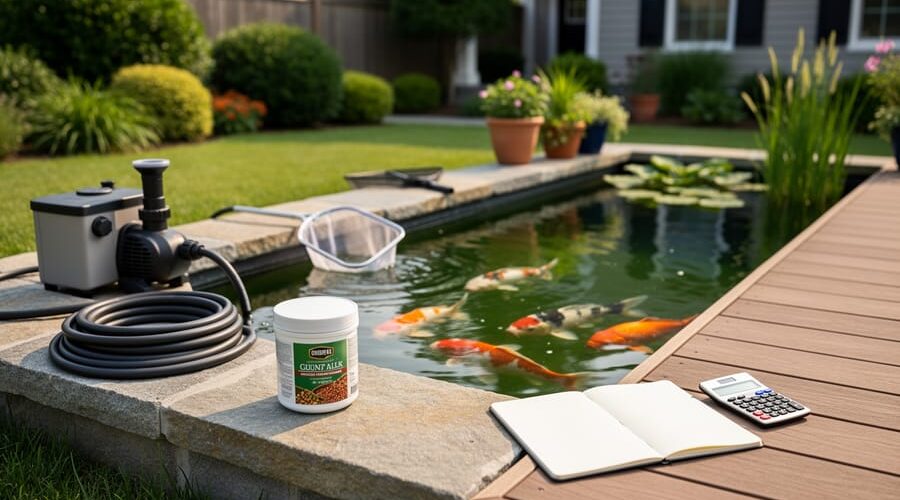
Track every expense during your first year of ownership in a simple spreadsheet or notebook. Most new pond owners underestimate recurring costs by 40-60% because they focus only on the build price from professional pond installation without accounting for electricity, water treatments, fish food, seasonal plant replacements, and equipment repairs.
Budget separately for three cost categories: predictable monthly expenses like electricity and fish food, seasonal costs such as winter preparations and spring cleanups, and emergency reserves for pump failures or unexpected leaks. Setting aside 10-15% of your pond’s initial construction cost annually covers most maintenance and replacement needs without financial surprises.
Understanding true ownership costs before breaking ground prevents buyer’s remorse and helps you design within sustainable limits. A well-planned pond brings years of enjoyment without straining your budget, while an underestimated investment becomes a source of stress. The difference lies not in the pond itself but in honest planning that accounts for the complete picture beyond installation day.
This guide breaks down every expense category you’ll encounter, from daily electricity consumption to once-a-decade liner replacements, giving you the realistic numbers needed for confident decision-making about your backyard water feature investment.
Understanding Total Cost of Ownership for Your Water Garden
The Two Types of Pond Costs You’ll Encounter
When I first started budgeting for my pond, I made a classic mistake. I focused entirely on what I needed to buy upfront and completely forgot that my pond would need ongoing care. It’s like buying a puppy and only budgeting for the adoption fee! Let me help you avoid that same oversight.
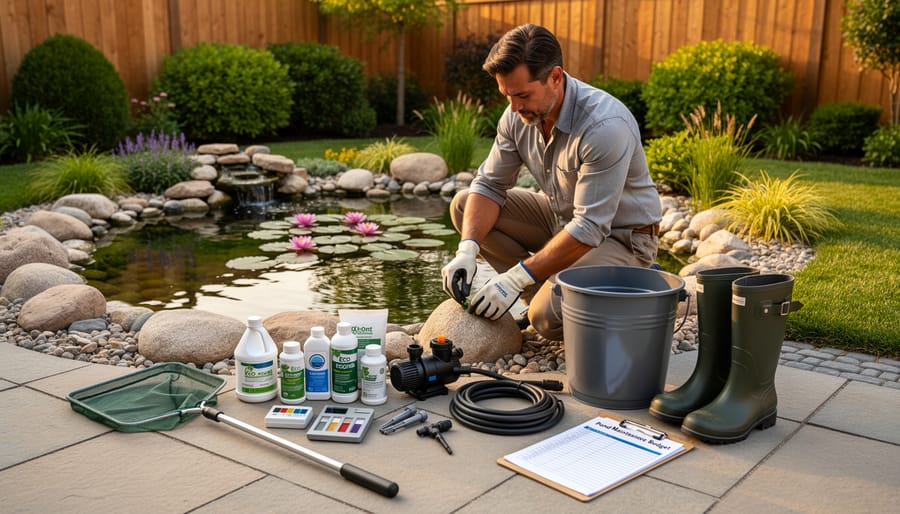
Think of pond costs in two distinct buckets. First, you have your one-time capital expenses. These are the big purchases you make during installation or major upgrades. We’re talking about items like your pond liner, filtration system, pump, rocks and boulders, plants, and any hardscaping materials. Once you buy these, they’re done (at least for several years). These expenses hurt the wallet initially, but then they’re behind you.
The second bucket contains your recurring operating expenses, and these are the ones that catch people off guard. These costs show up month after month, year after year. Your pump runs continuously, adding to your electricity bill. Fish need regular feeding. Your water requires seasonal treatments to maintain quality. Beneficial bacteria needs replenishing. Filter media wears out and needs replacing. During winter, you might need a de-icer to keep an opening in the ice.
Understanding this distinction helps you plan realistically. Your capital expenses are like a sprint, while operating expenses are a marathon. Both matter, but they require different budgeting strategies. Most pond owners find that operating costs are surprisingly manageable once they know what to expect and plan accordingly.
Your Pond’s Monthly Operating Expenses
Electricity: Keeping Everything Running
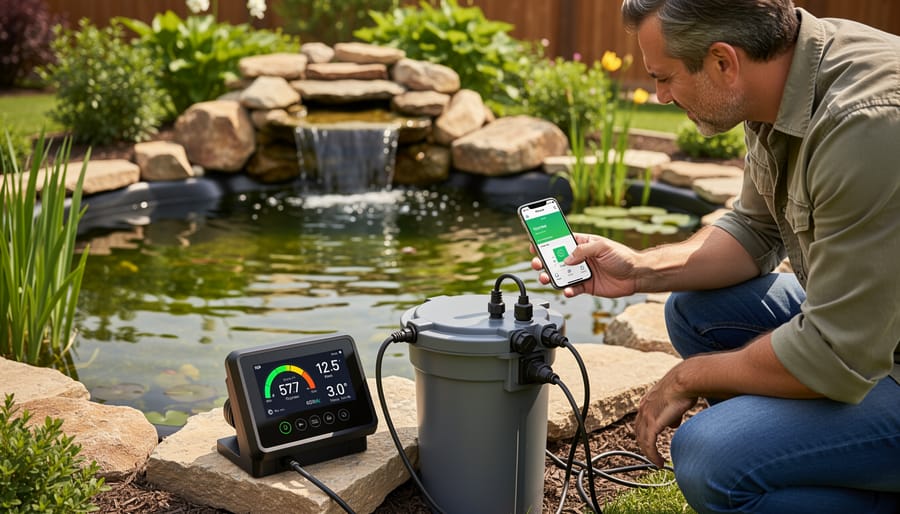
Let me tell you about something that caught me by surprise during my first year of pond ownership – the monthly electricity bill! While it’s not massive, your pond’s pump and filter do run 24/7 during the season, so it’s definitely worth factoring into your budget.
Here’s the reality: most pond pumps use between 50 to 200 watts, depending on your pond size and the type of pump you choose. Your filter might add another 20 to 50 watts if it has UV clarification. To figure out what this means for your wallet, you’ll need to do a quick calculation.
Let’s walk through it together. First, find the wattage on your pump’s label. For a typical 1,000-gallon pond, you might have a 100-watt pump. Multiply that by 24 hours, then by 30 days. That gives you 72,000 watt-hours, or 72 kilowatt-hours per month. Check your electric bill to see what you pay per kilowatt-hour – the national average is around 16 cents, though it varies widely by location. In this example, that’s about 11.50 dollars monthly, or roughly 70 dollars for a six-month season.
For larger ponds, the costs scale up proportionally. A 3,000-gallon pond might cost you 20 to 30 dollars monthly, while a 5,000-gallon water feature could run 35 to 50 dollars.
Want to keep costs down? Consider energy-efficient pumps with magnetic drive technology – they use about 30 percent less electricity than traditional models. Solar-powered pumps work beautifully for smaller ponds and fountain features, though they’re not quite powerful enough for large filtration systems yet. You can also use a timer to reduce waterfall operation during nighttime hours when you’re not enjoying it, though your main filtration pump should run continuously for healthy water.
Fish Food and Aquatic Pet Care
Feeding your finned friends is one of those joyful daily rituals that comes with pond ownership, and fortunately, it’s one of the more budget-friendly aspects of pond keeping! Let me break down what you can realistically expect to spend.
For a typical backyard pond with 10-15 koi or goldfish, you’ll spend roughly $15-30 per month on quality fish food during active feeding months. Smaller goldfish are economical eaters, while larger koi have heartier appetites. A 5-pound bag of premium floating pellets typically costs $20-40 and lasts about a month for a moderately stocked pond.
Here’s where seasonal variations really impact your budget: fish metabolism slows dramatically when water temperatures drop below 50°F, meaning they eat significantly less or stop feeding entirely in winter. This natural pause gives your wallet a break for 3-5 months annually, depending on your climate. During spring and fall transition periods, you’ll use about half the food compared to summer’s peak feeding season.
Beyond basic nutrition, you might occasionally invest in supplemental products. Wheat germ-based food for cooler months runs $25-35 per bag, while color-enhancing formulas cost slightly more at $30-50. Health boosters like vitamin supplements or probiotic-enriched foods add another $10-20 monthly if you choose to use them.
Annual feeding costs typically range from $150-400, making fish food surprisingly affordable compared to other pet ownership expenses. My advice? Buy in bulk during sales and store food in airtight containers to maintain freshness and maximize your investment.
Water Treatments and Maintenance Supplies
Keeping your pond water healthy doesn’t have to break the bank, but it does require some regular investment. Let me walk you through what you’ll actually need versus what’s nice to have.
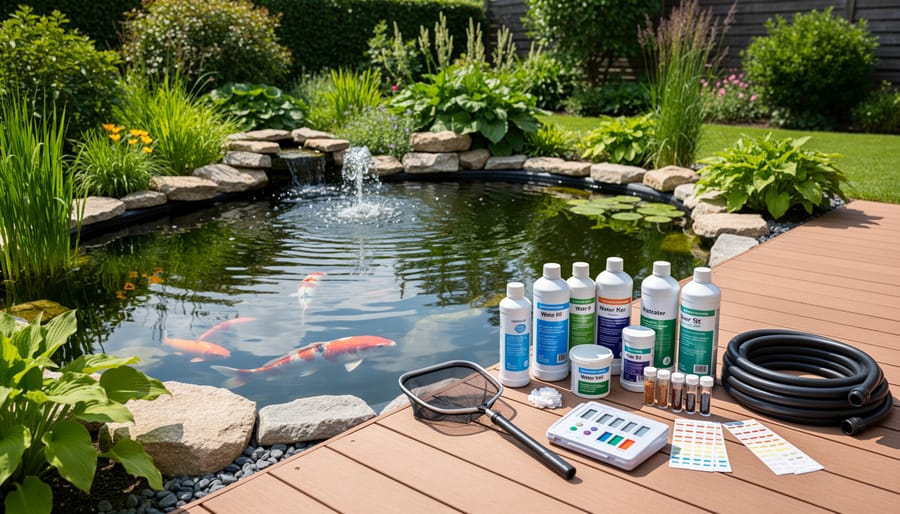
Your essential monthly expenses start with beneficial bacteria, which typically runs $15-30 per month depending on your pond size. Think of these as your pond’s invisible cleaning crew—they break down fish waste and debris naturally. I’ve learned the hard way that skipping this to save money usually leads to bigger problems (and bigger bills) down the road.
Water conditioners are another must-have, especially if you’re adding tap water during top-offs. Budget around $10-20 per month. These neutralize harmful chlorine and heavy metals that can stress your fish.
For test kits, you’ll spend about $20-40 initially, and they last several months. Testing pH, ammonia, and nitrite levels regularly helps you catch problems before they become expensive emergencies. I check mine weekly during summer and bi-weekly in cooler months.
Algae treatments fall into the “it depends” category. If your pond has good filtration and isn’t overstocked, you might only need treatments occasionally—maybe $50-100 per season. String algae removers and UV clarifier bulbs (replaced annually at $30-80) can help manage green water naturally.
Seasonal treatments add another $50-150 yearly. Cold water bacteria for fall, sludge reducers for spring cleaning, and perhaps a barley straw extract for algae prevention round out your maintenance arsenal.
Overall, expect $50-100 monthly for water treatments, with seasonal spikes during spring startup and fall preparation.
Plant Care and Replacement
Your pond’s plants need some love throughout the year, and that comes with a modest but ongoing investment. Think of it as refreshing your garden beds, just wetter!
Water lilies and marginal plants benefit from fertilizer tablets during the growing season. These specialized aquatic fertilizers typically cost $15-25 per container and last several months. I push fertilizer tablets into the soil of my potted lilies every 4-6 weeks from spring through late summer, and the blooms are absolutely worth it.
Expect to replace or divide plants every few years. Hardy water lilies can last indefinitely with division, but tropical varieties need annual replacement in colder climates. Budget $20-50 annually for new plants or replacements. Some marginals grow aggressively and need thinning, which actually saves money since you can relocate divisions rather than buying new.
Seasonal rotation keeps your pond looking fresh. I swap out tired summer plants for fall grasses and winter-hardy varieties. Annual plant refresh costs vary widely based on your preferences, but $50-100 per year covers most pond owners’ needs.
The beauty is that plants actually reduce other costs by providing natural filtration and competing with algae. Consider plant care an investment that pays dividends in water quality and visual appeal.
Water Bills: The Hidden Cost
Water often feels like the cheapest part of pond ownership until you start tallying those monthly bills! The initial fill can be surprisingly costly depending on your pond size. A 1,000-gallon pond might add $5-15 to your water bill right off the bat, while larger ponds of 5,000 gallons or more could run $25-75 just to fill initially.
The real ongoing expense comes from evaporation, especially during those hot summer months. I learned this the hard way my first summer when I noticed I was adding 50-100 gallons weekly! Evaporation rates vary by climate, but expect to lose 1-2 inches of water per week in peak summer. That translates to roughly 100-300 gallons monthly for an average-sized pond.
Don’t forget about water loss from splashing waterfalls, playful fish activity, and occasional overflow during heavy rains when you’ve got your system running. These “invisible” losses can add another 50-100 gallons monthly. Budget around $10-30 monthly during active months for topping off your pond, with higher costs in arid climates.
The Seasonal and Occasional Expenses
Spring Start-Up and Fall Shutdown
Twice a year, you’ll need to budget for transitional maintenance that keeps your pond healthy through seasonal changes. In spring, count on spending $50-150 to get your pond back in action after winter. This includes beneficial bacteria starter bottles to jumpstart your biological filtration (around $20-40), water conditioners to neutralize any accumulated toxins ($15-25), and cleaning supplies like pond-safe brushes and nets ($20-30). You might also need to replace filter media that’s worn out over winter, adding another $30-80 depending on your system.
Fall shutdown requires similar investment, typically $40-100. Netting to keep autumn leaves out of your pond runs $20-60 depending on size. If you live where temperatures drop below freezing, you’ll need winterization products like cold water bacteria formulations ($15-30) and possibly a pond de-icer ($40-80 as a one-time purchase that lasts several years). Some folks also add autumn prep treatments to help fish build up reserves before winter dormancy.
The good news? Many of these products last multiple seasons, so your costs decrease after that first year. I always stock up on essentials during end-of-season sales, saving 20-30% for next year.
Equipment Replacement and Repairs
Let me be honest with you—nothing lasts forever, and that includes pond equipment. But here’s the good news: when you know what to expect, you can plan ahead and avoid those heart-stopping moments when something fails.
Your pond pump is the hardworking heart of your system, and most quality pumps last between 3 to 5 years with proper maintenance. I learned this the hard way when my first pump gave out after four years, and I hadn’t budgeted for it. Now I set aside a little each month, treating it like a car payment that eventually pays off. Expect to spend anywhere from $150 to $600 for a replacement, depending on your pond size.
UV clarifiers typically need new bulbs annually, costing around $50 to $100, but the entire unit might need replacing every 5 to 7 years. The bulbs lose effectiveness even when they still glow, so don’t skip this replacement—your crystal-clear water depends on it.
Pond liners are the marathon runners of pond equipment, often lasting 15 to 25 years. Quality EPDM liners can even exceed this with proper installation. If you’re not confident installing a new liner yourself, hiring a pond contractor can ensure it’s done right the first time.
My advice? Create a simple replacement fund. Calculate the total replacement cost of all equipment, divide by their expected lifespan in months, and save that amount monthly. For a typical 1,000-gallon pond, that’s roughly $30 to $50 monthly—painless when spread out, manageable when the time comes.
Emergency Fund Essentials
Here’s the thing about ponds—they don’t always wait for payday to surprise you! I learned this lesson when my pump decided to quit on the hottest day of summer. Setting aside a small emergency fund (think $200-500 depending on your pond size) can be a real lifesaver when unexpected situations pop up. Leaks happen, fish can get sick and need medication, and equipment doesn’t always give you a warning before it fails. Without this cushion, a sudden $150 pump replacement or a $75 bottle of fish medication can throw your whole budget off track. Trust me, you’ll sleep better knowing you’ve got a safety net. Consider it like insurance for your backyard oasis—hopefully you won’t need it often, but when you do, you’ll be so grateful it’s there. Start small if needed, even setting aside $20 monthly builds up quickly!
Smart Ways to Reduce Your Pond’s Operating Costs
Energy-Saving Equipment Choices
Here’s where you can really make a difference in your long-term pond costs! When I upgraded to an energy-efficient pump, my summer electricity bills dropped noticeably, and that feeling of being both eco-friendly and wallet-friendly? Absolutely worth it.
Start by looking for pumps with the Energy Star label or those specifically marketed as low-energy models. Yes, they cost more upfront, sometimes 30-50% more than standard pumps, but they typically use 25-40% less electricity. Do the math for your situation: multiply your pump’s wattage by your local electricity rate and hours of daily operation. You’ll quickly see how a more efficient pump pays for itself within 1-3 years.
Solar-powered options have come a long way. For smaller ponds or fountain features, solar pumps can eliminate electricity costs entirely. They work beautifully in sunny locations, though you’ll want a battery backup system for cloudy days.
Don’t overlook simple timer switches! Running your pump 12-16 hours daily instead of 24/7 can cut electricity costs nearly in half while still maintaining healthy water circulation. This works especially well if you don’t have fish or have a lightly stocked pond.
Consider upgrading when your pump is 5-7 years old, even if it still works. Newer models are significantly more efficient than older technology.
Natural Solutions That Save Money
Here’s a secret I discovered after years of fighting algae with expensive chemicals: nature already has the perfect filtration system built in! Once I stopped working against it and started embracing natural solutions, my maintenance costs dropped dramatically.
Plants are your best friends when it comes to keeping water clear. Water lilies, marginal plants, and submerged vegetation naturally compete with algae for nutrients, essentially doing the job of expensive filtration systems. I added a bunch of hornwort and water hyacinth to my pond one spring, and within weeks, my water clarity improved without any chemical intervention. Best part? Plants cost a fraction of mechanical filters and keep working year after year.
Beneficial bacteria products get a lot of hype, but you can cultivate these helpful microorganisms naturally by simply adding rocks, gravel, and avoiding over-cleaning. Those slimy surfaces you might be tempted to scrub? They’re actually hosting colonies of bacteria that break down fish waste and organic matter for free.
Creating shallow planting shelves around your pond edges provides habitat for these beneficial organisms while giving you space for natural filtration through plant roots. This approach saves money on both equipment and chemicals while creating a healthier, more balanced ecosystem that practically maintains itself.
DIY Maintenance That Actually Works
You can tackle many pond tasks yourself and save hundreds annually! Water testing, filter cleaning, and debris removal are simple jobs anyone can master. I’ve been making my own beneficial bacteria cultures for years using organic materials—it costs pennies compared to store-bought bottles. Just strain old pond water through cheesecloth and add molasses to feed the good bacteria.
Know your limits though. Complex equipment repairs, major leak fixes, or structural work warrant calling a professional pond contractor. I learned this the hard way after a DIY pump repair turned into a costly replacement.
Smart shopping means buying supplies in bulk during off-season sales. Join online pond forums where members share discount codes and equipment reviews. Consider buying quality used equipment—many pond keepers upgrade unnecessarily and sell perfectly good gear. I’ve furnished entire filtration systems this way, cutting costs by sixty percent while maintaining excellent water quality.
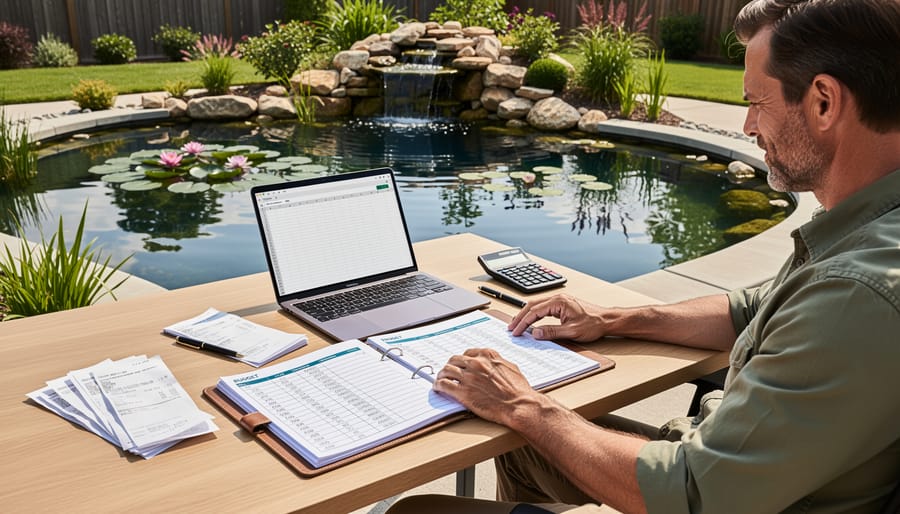
Planning Your First-Year Pond Budget
Let me give you some real numbers to work with! When I built my first pond, I wish someone had handed me a realistic budget breakdown. I thought I was just spending money once, but quickly learned that ponds are living systems that need ongoing care and investment.
Here’s what you can expect to spend in your first year, broken down by pond size. These figures include everything from planning your pond through your first twelve months of operation.
For a small pond (up to 500 gallons), budget around $800-$1,200 for the first year. This includes your initial setup costs like a basic pump and filtration system ($200-$400), plants and initial fish ($100-$200), water treatments and test kits ($80-$120), electricity for running your pump ($60-$100 annually), seasonal maintenance supplies ($150-$200), and a buffer for unexpected issues ($200-$300). Small ponds are wonderfully manageable and won’t break the bank.
Medium ponds (500-2,000 gallons) require a bigger commitment of $1,800-$3,000 in year one. You’ll need more robust equipment, with pumps and filters running $500-$800, a more diverse plant and fish collection ($300-$500), increased water treatment needs ($150-$250), higher electricity costs ($120-$200), more extensive maintenance supplies ($300-$450), and a larger emergency fund ($400-$600). This is the sweet spot for many water gardeners, offering plenty of visual impact without overwhelming costs.
Large ponds (over 2,000 gallons) will set you back $3,500-$6,000 or more in the first year. Professional-grade equipment starts at $1,000-$2,000, stocking costs can reach $600-$1,000, water treatments and testing run $250-$400, electricity jumps to $200-$400 annually, maintenance supplies cost $500-$800, and you should reserve $800-$1,200 for unexpected expenses. These showcase ponds create stunning outdoor spaces but require serious financial commitment.
Remember, these are starting points. Your actual costs will vary based on your location, specific equipment choices, and how elaborate you want your water feature to be. The good news? Years two and beyond typically cost 40-60% less since you’ve already made the major equipment investments.
Here’s the truth I’ve learned after years of splashing around in the pond world: yes, owning a pond costs money. But here’s the beautiful part—it’s absolutely manageable when you know what’s coming. Think of it like owning a car. You wouldn’t skip oil changes or be surprised when tires eventually need replacing, right? Ponds work the same way.
The real secret to happy pond ownership isn’t having unlimited funds. It’s being informed and planning ahead. When you budget for electricity, set aside a bit each month for filter media, and aren’t caught off guard by that occasional pump replacement, pond care becomes just another part of your routine. No stress, no surprises, just enjoyment.
I’ve met countless pond owners who absolutely glow when talking about their water gardens. They’ll tell you about the fish that eat from their hands, the peaceful sound of flowing water after a long day, and how their backyard has become the neighborhood gathering spot. Not one of them ever said, “I regret it because of the costs.” They simply planned, budgeted, and enjoyed.
So here’s my encouragement to you: start tracking your expenses today. Create a simple spreadsheet or use a notebook to jot down what you spend each month. You’ll quickly see patterns, know exactly where your money goes, and feel confident in your pond journey. Informed pond owners are genuinely happy pond owners, and that can absolutely be you.