
Turn Your Backyard Pond Into a Preschool Wonderland (Activities That Actually Work)
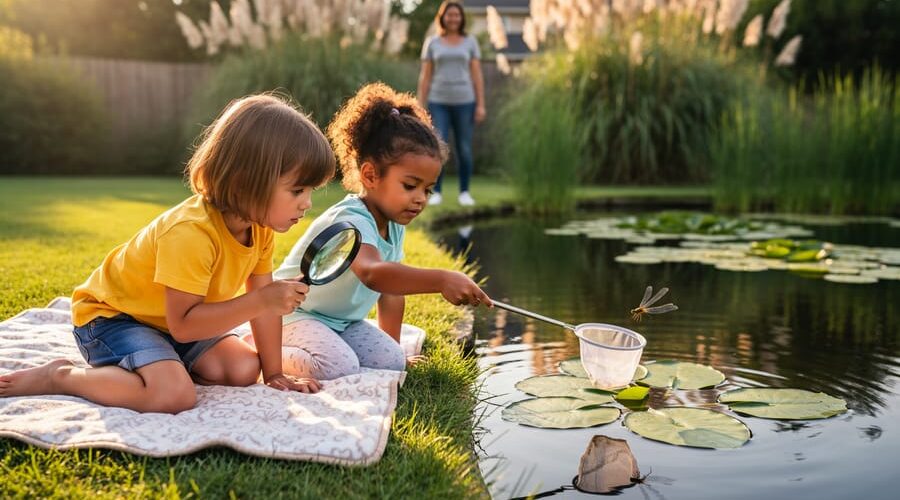
Transform your backyard pond into a living classroom where preschoolers discover nature’s wonders through safe, hands-on exploration. Position children at least three feet back from the water’s edge and establish a firm “look but don’t lean” rule before every pond visit. Equip little learners with child-safe magnifying glasses, plastic containers with lids, and long-handled nets designed specifically for small hands to observe pond life without direct water contact.
Start with simple observation activities that build curiosity without risk. Have children lie on their bellies on a blanket to watch water striders skate across the surface, count lily pads, or track how dragonflies hover and dive. Create a pond journal using a simple notebook where they draw what they see each visit, building observation skills and scientific thinking from their earliest years.
Schedule pond time during mild weather when children can focus on learning rather than discomfort, and always maintain a one-to-one or one-to-two adult-to-child ratio. The shallow areas near your pond’s edge become natural science labs where tadpoles transform, where beneficial insects gather, and where plants show their growth cycles in real time. These aren’t just outdoor play sessions but foundational experiences that teach responsibility, patience, and respect for living ecosystems.
Your pond offers what no screen or textbook can replicate: the authentic thrill of discovering a frog’s hiding spot, the patience required to watch a butterfly land on a flower, and the wonder of seeing their reflection alongside clouds in still water.
Why Your Pond Is Perfect for Preschool Learning
Your backyard pond isn’t just beautiful—it’s a living classroom that offers something screens and indoor toys simply can’t match. When my niece first peered into my pond, her eyes lit up watching the water striders dance across the surface. That moment of pure wonder? That’s exactly what makes pond-based learning so powerful for preschoolers.
Young children are natural scientists, constantly exploring through their senses. A pond provides endless opportunities for this discovery. The cool splash of water, the rough texture of rocks, the gentle movement of plants swaying—these sensory experiences build neural connections that support cognitive development. Unlike passive entertainment, pond activities engage multiple senses simultaneously, helping little ones make sense of their world.
Curiosity flourishes at the water’s edge. Questions bubble up naturally: “Why do leaves float?” “Where do the frogs go in winter?” This questioning forms the foundation of critical thinking skills they’ll use throughout life. By creating your own wildlife haven, you’re offering front-row seats to nature’s daily dramas.
The garden therapy benefits extend to our youngest learners too. Studies show that children who spend time in nature demonstrate improved focus, reduced stress, and better emotional regulation.
Now, I know what you’re thinking—safety. It’s the first concern every parent has, and rightly so. The key is supervision and simple boundaries. Establish clear rules before activities begin, create designated observation spots away from deep edges, and always remain within arm’s reach. With these precautions, your pond transforms from a worry into a wonderful learning space that nurtures both mind and spirit.
Safety First: Setting Up Your Pond Area for Little Learners
Creating Safe Viewing Boundaries
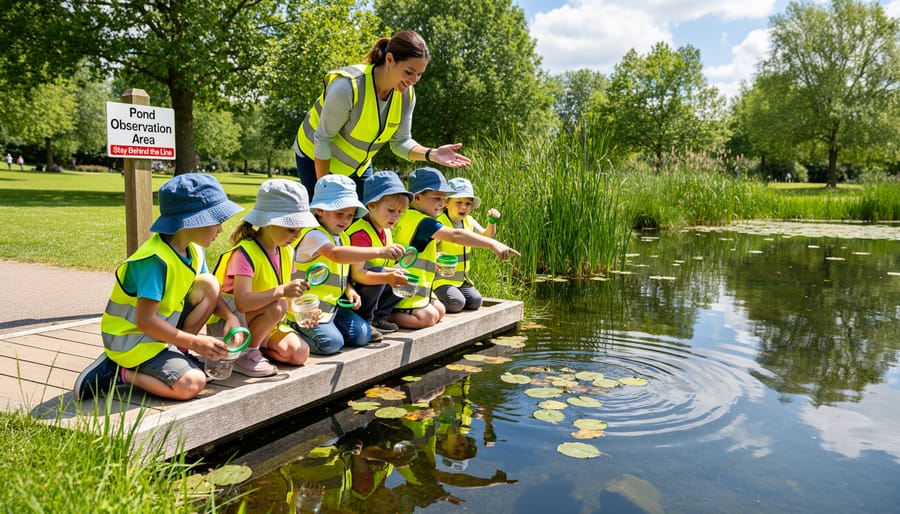
Before any preschool pond activities begin, you’ll want to create clear physical boundaries that keep little ones at a safe distance from the water’s edge. Trust me, active preschoolers can move surprisingly fast, so taking time to set up proper barriers is absolutely essential.
Start by establishing a viewing line at least three feet back from the pond edge. Temporary garden fencing works wonderfully for this – the lightweight plastic or wire mesh varieties are affordable, easy to install, and can be removed when the kids aren’t around. Simply stake the fencing sections into the ground, overlapping each piece slightly for stability.
For a softer approach, create a rope barrier using colorful twisted rope strung between garden stakes. This works best when you tie bright fabric strips or flags along the rope at twelve-inch intervals, making it highly visible to young eyes. Position the rope at waist-height for preschoolers.
Designate specific sitting areas using outdoor mats, blankets, or even chalk circles on nearby pavement. These become the official observation zones where children gather during pond activities. I’ve found that giving kids their own special spot helps them understand boundaries while making them feel included in the experience.
Always position yourself between the children and the water, and consider having a second adult stationed at the opposite side for additional supervision during group activities.
Essential Safety Rules for Pond Play
Before your little ones dip their toes into pond exploration, let’s establish some simple safety rules that even the youngest adventurers can understand and follow.
Start with the golden rule: always have a grown-up nearby. I make this fun by calling myself the “Pond Buddy” – no one explores without their buddy! Keep this ratio strict: one adult for every two to three preschoolers near water.
Create a clear boundary line using colorful rope, pool noodles, or garden stakes placed about two feet from the water’s edge. This is the “stop line” where little feet must pause. Practice this boundary during your first visit without any pond activities, so children understand it’s non-negotiable.
Teach the “look but don’t lean” rule. Preschoolers love getting close, but leaning over water is risky. Instead, show them how to crouch down or sit on their bottoms to observe safely.
Introduce the “hands are for holding” concept – hands hold nets, magnifying glasses, or an adult’s hand, but never reach into the pond independently. This prevents slips and protects curious fingers from unexpected encounters.
Finally, establish a “one activity at a time” approach. Running near water and pond play don’t mix. When it’s pond time, we walk carefully and save our wiggles for later.
Observation and Discovery Activities
Pond Life Spotting Games
Turning pond exploration into playful games keeps little ones engaged while sharpening their observation skills. I’ve found that preschoolers absolutely love the challenge of finding specific things when it feels like a treasure hunt rather than just looking around.
Start with a simple “I Spy” checklist featuring pictures instead of words. Draw or print images of common pond inhabitants and plants your children might spot: dragonflies, frogs, lily pads, ducks, or water striders. Laminate these checklists so they’re waterproof and can be reused throughout the seasons. Hand each child a washable marker to check off their discoveries. The excitement on their faces when they spot something new is absolutely priceless!
Magnifying glasses transform ordinary observations into extraordinary adventures. Even a basic magnifying glass helps preschoolers examine the intricate details of leaves floating on the water’s surface, the patterns on a dragonfly’s wings, or the texture of pond plants growing along the edge. This hands-on tool makes children feel like real scientists conducting important research.
Create simple counting games that match your pond’s inhabitants. “Can you count five lily pads?” or “How many ducks do you see?” works wonderfully for early math skills. Keep activities short since preschoolers have limited attention spans, usually around 10-15 minutes works best.
For added fun, turn findings into a tally chart back inside. Children can draw what they saw and count up their discoveries together, reinforcing both memory and counting skills while safely away from the water’s edge.
Seasonal Changes Journal
Creating a seasonal pond journal is one of my favorite ways to help preschoolers slow down and really notice the world around them. I started this activity with my niece when she was four, and watching her excitement as she spotted changes month after month was absolutely magical.
Start by giving each child a simple notebook or folder with blank pages. During each pond visit throughout the year, dedicate ten minutes to observation time. Encourage your little ones to look carefully at the water, plants, and any creatures they spot. What colors do they see? Are there leaves floating? Is the water still or moving?
For younger preschoolers, let them draw what they see using crayons or colored pencils. Don’t worry about artistic perfection—stick figures and squiggly lines are wonderful. The goal is documentation, not masterpieces. As they draw, ask gentle questions: “What’s different from last time?” or “Do you see more green today?”
Slightly older preschoolers can dictate short sentences while you write them down, like “The pond is icy” or “I saw three frogs today.” Add the date to each entry so you can look back together and see patterns.
Consider adding extra elements like pressing leaves between wax paper to tape into journals or taking photos with a simple camera. After a full year, flip through the journal together and celebrate how much they’ve learned about their pond’s changing personality through the seasons.
Hands-On Water Play Activities (Safe Distance from Pond)
Pond Water Sensory Bins
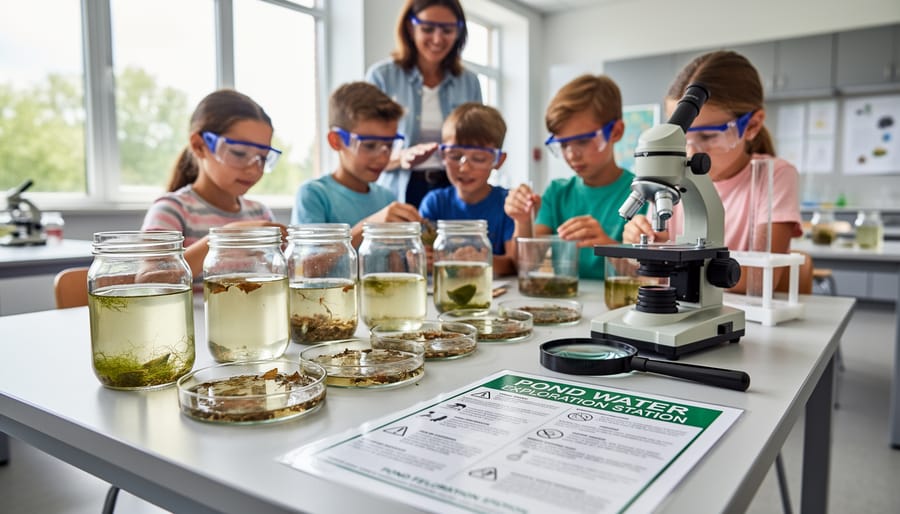
Creating a pond water sensory bin brings the magic of your water feature right to your little learner’s fingertips! I love setting these up on warm afternoons because they give preschoolers hands-on pond exploration in a controlled, safe environment.
Start with shallow, wide containers like plastic storage bins or large baking dishes. Fill them with a few inches of pond water you’ve collected and inspected for safety. Add pond-safe elements like smooth river rocks, floating leaves, pond snail shells (empty ones), and artificial lily pads cut from craft foam.
Here’s my favorite combination: one bin with pond water and aquatic plants like water lettuce snippets, another with wet sand and pebbles for “pond building,” and a third with just clear water and plastic toy frogs or fish. This variety keeps preschoolers engaged while targeting different sensory experiences.
Always supervise closely during sensory play. Keep the water level low, change it frequently, and have towels ready for enthusiastic splashing. Add measuring cups, turkey basters, and small nets so children can scoop, pour, and transfer materials between bins.
Set up your sensory station in a shaded area and plan for 20-30 minute sessions. The hands-on exploration helps preschoolers understand pond ecosystems while developing fine motor skills and scientific thinking through safe, guided discovery.
Floating and Sinking Experiments
Bring the wonder of your pond to preschoolers with simple floating and sinking experiments! Fill a large bucket or plastic tub with fresh pond water and gather natural materials from around your water garden. This hands-on science activity teaches basic physics while letting little ones explore safely.
Start by collecting items together: leaves, twigs, pebbles, pine cones, flower petals, and feathers work beautifully. I love watching children’s faces light up when they make predictions about what will happen. Before each item goes in the water, ask them to guess whether it will float or sink.
Let each child gently place their chosen object on the water’s surface. You’ll hear squeals of delight when a surprisingly heavy pine cone floats, or when a delicate leaf sinks right away. Create two sorting areas on a towel nearby, one for floaters and one for sinkers, so children can categorize their discoveries.
This activity naturally extends into water games as children experiment with making sinkers float using leaves as boats. For added learning, introduce simple vocabulary like buoyancy and weight. Keep towels handy and embrace the splashes as part of the fun. This experiment works wonderfully any time of year and requires minimal setup while delivering maximum educational value.
Creative Pond-Inspired Crafts and Games
Frog and Fish Movement Games
Getting little ones moving like pond creatures is pure joy! These movement games burn energy while teaching kids about how frogs and fish get around their watery homes.
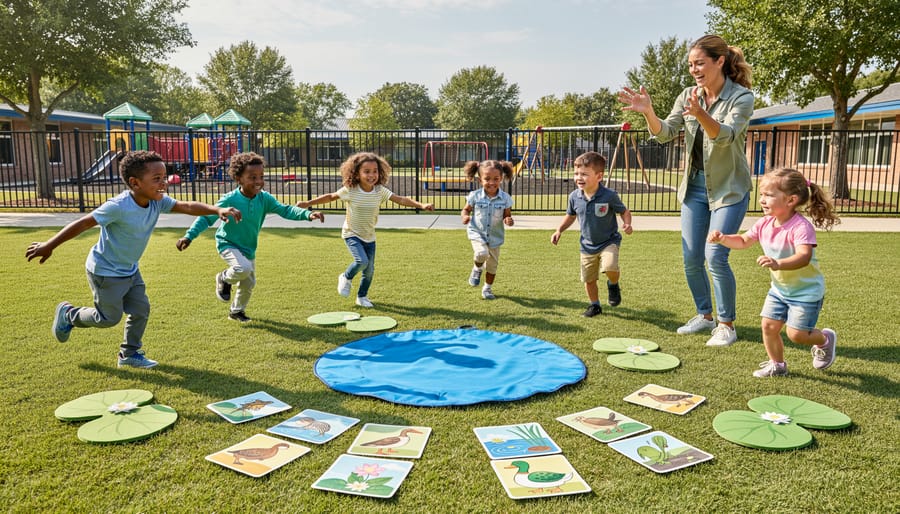
Start with the classic Leap Frog game. Have children squat low like frogs waiting on lily pads, then spring forward with big jumps. Challenge them to see who can jump the farthest or create a simple obstacle course where they must hop between “lily pads” made from green paper plates or towels placed around your yard.
For fish movements, encourage preschoolers to lie on their bellies and wiggle across the grass, using their arms to propel themselves forward like swimming fish. You can play Freeze Fish where kids swim around freely until you call out “freeze!” and they must stop mid-wiggle. This teaches self-control while keeping them giggling.
Try the Pond Creature Dance where you call out different animals and children switch their movements. “Frog!” means hopping. “Fish!” means swimming motions with arms. “Turtle!” means slow crawling. “Dragonfly!” means running with arms spread wide.
For group play, create a simple Red Light, Green Light variation called “Frog Cross the Pond” where children hop toward you, freezing when you call out potential predators. These games help develop gross motor skills, balance, and coordination while connecting physical activity to pond life education.
Nature Art with Pond Materials
Getting creative with natural materials from your pond is a wonderful way to extend the learning experience indoors. I love watching preschoolers transform simple pond finds into unique artwork that they’re genuinely proud of!
Start by collecting safe materials during your pond visits. Fallen leaves, cattail fluff (once completely dried), smooth pebbles, and pressed pond plants work beautifully. Always supervise collection and make sure everything is completely dry before crafting to prevent mold. I’ve found that laying items flat in the sun for a few days does the trick perfectly.
For painting projects, create pond-themed art using blue and green paints with simple stamping tools. Cut sponges into fish or lily pad shapes, or use actual leaves as stamps. Preschoolers can press leaves into paint and then onto paper, creating beautiful texture prints. Another favorite is making collages by gluing dried grasses and small leaves onto cardstock to recreate pond scenes.
Rock painting is always a hit with this age group. Let children paint collected pond stones to look like frogs, turtles, or colorful fish. Use non-toxic, washable paints and keep designs simple. These painted rocks can even return to the pond area as garden decorations, giving kids pride in contributing to the outdoor space they’ve been exploring.
Teaching Moments: Simple Pond Ecology for Preschoolers
The Food Chain Made Simple
Little ones grasp concepts best through simple comparisons they already understand. Start by explaining the pond food chain like a cafeteria line: tiny plants and algae are like the salad bar, small bugs munch on those plants, little fish eat the bugs, and bigger fish eat the smaller fish. It’s just like how we all need different foods to grow strong!
Create a visual chain using construction paper cutouts. Draw algae at the bottom, then insects, small fish, and finally a large fish or frog at the top. Connect them with arrows showing who eats whom. You can even use toy pond animals and arrange them in order on the ground, making the concept tangible.
I love using the “big mouth, little mouth” game with my young visitors. Have children compare their own mouths to pictures of different pond creatures, discussing what size food each animal needs. A mosquito has a tiny straw-like mouth for plant juice, while a bass has a big mouth for catching fish. This playful approach makes food chains memorable and fun without overwhelming preschoolers with complex ecological terminology.
Why Water Is Important for Animals
Before diving into pond activities, it’s wonderful to help little ones understand why ponds are so special to the creatures living there. Think of a pond as a neighborhood where everyone depends on water for different reasons!
Fish need water to breathe through their gills, just like we need air. Frogs start their lives as tadpoles swimming in the water before they grow legs and hop onto lily pads. Dragonflies lay their eggs in the water, and their babies live underwater for months before becoming the beautiful flying insects we see zipping around.
Birds visit ponds for refreshing drinks and baths, especially on hot days. Even tiny insects like water striders use the pond’s surface as their skating rink home!
When you’re exploring with your preschoolers, point out how different animals interact with the water. Some live in it full-time, others visit for meals or drinks, and some use it as a safe nursery for their babies. This simple observation helps children understand that ponds aren’t just pretty features in your yard – they’re bustling communities full of life that depends on that precious water every single day.
Adapting Activities for Different Seasons
Your pond transforms with each season, offering fresh learning opportunities throughout the year! I’ve found that embracing seasonal changes keeps preschoolers engaged and helps them understand nature’s cycles.
During spring, focus on awakening life. Watch for tadpoles hatching and plants sprouting new growth. Create a spring scavenger hunt where children look for first leaves, baby insects, or returning birds. Set up a simple weather station nearby to track spring rainfall and temperature changes. This is also perfect for planting pond-edge flowers together.
Summer brings abundant activity. Early morning pond visits reveal the most wildlife before heat sets in. Try simple evaporation experiments by marking water levels in clear containers. Create mud pies using pond-edge soil (safely away from the water) and let kids mold leaf imprints. Float homemade boats made from natural materials and observe how they move. Remember, supervision is absolutely essential during warmer months when water is most tempting.
Autumn offers spectacular teaching moments. Collect fallen leaves and sort them by color, size, or type. Watch how leaves float and eventually sink, discussing decomposition in simple terms. Observe migrating birds stopping by for a drink. Document how your pond’s edge plants change color and prepare for winter.
Winter might seem limiting, but it’s magical. If your pond freezes, examine ice patterns from a safe distance. Look for animal tracks in surrounding mud or snow. Discuss where pond creatures go when it’s cold. On milder days, continue bird watching as feathered friends appreciate winter water sources. For families interested in extending pond learning beyond daylight hours, nighttime pond activities during warmer seasons can reveal nocturnal visitors and create memorable experiences.
You don’t need an elaborate setup or complicated lesson plans to introduce preschoolers to the wonders of pond life. Start with simple activities like watching tadpoles swim or collecting fallen leaves near the water’s edge. These small moments of discovery often become the experiences children remember most vividly as they grow.
Outdoor learning at your pond offers something no classroom can replicate—the genuine excitement of observing nature unfold in real time. Your peaceful pond environment naturally sparks curiosity, develops observation skills, and creates connections between children and the natural world around them. Whether you’re a parent, homeschooler, or educator, these pond experiences build lasting memories while teaching valuable lessons about ecosystems and environmental stewardship.
Ready to dive deeper into making the most of your pond? Explore our collection of pond resources for more ideas on creating educational and recreational experiences for the whole family. Your backyard pond is more than just a beautiful feature—it’s an outdoor classroom waiting to inspire young minds.