
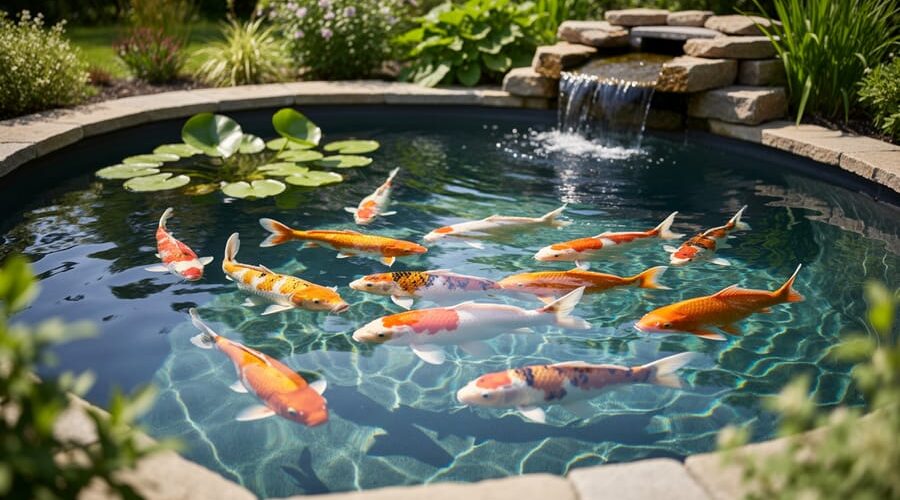
Why 250 Fish in Your Pond Could Be a Disaster (Or Perfectly Fine)
Calculate your pond’s volume by measuring length times width times average depth, then multiply by 7.5 to get gallons. This tells you if your 250 fish are comfortably housed or dangerously overcrowded. A standard rule suggests one inch of fish per 10 gallons of water, so 250 six-inch koi would need at least 15,000 gallons, while 250 three-inch goldfish could thrive in 7,500 gallons.
Test your water weekly for ammonia, nitrite, and nitrate levels using a simple liquid test kit from any pet store. Ammonia above 0.25 ppm or nitrite above 0.5 ppm signals overcrowding stress, meaning your biological filter can’t handle the fish waste load. High nitrate readings above 40 ppm confirm too many fish are producing waste faster than your pond’s ecosystem can process it.
Watch your fish’s behavior during morning feeding times. Healthy populations swim actively with fins erect and respond enthusiastically to food. Overcrowded fish gasp at the surface, clamp their fins against their bodies, or show little interest in eating. These warning signs appear before water quality issues become fatal.
Examine your filtration capacity against your fish load. Your filter should process your entire pond volume at least once per hour for 250 fish, but twice per hour provides better water clarity and health. Upgrading your pump and adding a second biological filter often solves overcrowding problems without reducing fish numbers.
The truth is, 250 fish isn’t automatically too many or too few. Your specific pond volume, filtration system, and maintenance routine determine success. Let’s figure out where you stand and what adjustments will keep your underwater community thriving.
What Carrying Capacity Actually Means for Your Pond

The Real Factors That Determine How Many Fish Your Pond Can Handle
Let me tell you something I learned the hard way during my first year of pond keeping: throwing fish into water isn’t enough. You need to understand what actually makes a pond livable, and honestly, it’s not as complicated as some experts make it sound.
Think of your pond like an apartment building. You wouldn’t cram 250 people into a studio flat, right? The same logic applies to fish. The magic number isn’t really about how many fish you have, it’s about whether your pond has the infrastructure to support them.
First up is pond volume. This is your foundation. A good rule of thumb is allowing 10 gallons of water per inch of fish. So if you’re eyeing 250 goldfish at about 4 inches each, you’d need roughly 10,000 gallons. To calculate your pond’s volume, multiply length times width times average depth, then multiply by 7.5 for gallons. Got an irregularly shaped pond? Break it into sections and add them together.
Surface area matters even more than volume because that’s where oxygen exchange happens. Water breathes through its surface, so a shallow, wide pond can often support more fish than a deep, narrow one of the same volume. Calculate surface area by simply multiplying length times width at the water’s surface.
Now let’s talk about your pond’s life support systems. Filtration is non-negotiable with higher fish populations. Your filter should process your entire pond volume at least once every two hours. For 250 fish, you’ll likely need a substantial biological filter that can handle the waste load. Don’t skimp here.
Aeration is equally crucial. Beyond natural oxygenation methods, consider adding air pumps, waterfalls, or fountains. These keep oxygen levels stable, especially during hot summer months when warm water holds less dissolved oxygen.
Finally, don’t forget about stocking density ratios. A conservative approach is one inch of fish per square foot of surface area. Measure your fish from nose to tail tip, add up those inches, then compare to your surface area. This quick check often reveals whether you’re pushing capacity limits before problems arise.
Is 250 Fish Too Many for Your Pond?
Quick Reference: Pond Size vs. Fish Population Guidelines
Let me help you understand the basic guidelines for matching fish populations to your pond size. Think of this as your go-to cheat sheet when planning your water garden!
The most common rule you’ll hear is the “inch per gallon” guideline. Here’s how it works: for every inch of adult fish length, you need one gallon of water. So a 6-inch goldfish needs 6 gallons. Sounds simple, right? Well, here’s where it gets interesting. This rule has some pretty significant limitations that every pond keeper should know about.
First, this guideline was originally developed for aquariums, not outdoor ponds. Ponds have completely different dynamics with natural filtration, temperature fluctuations, and oxygen levels. Second, it doesn’t account for fish growth. That adorable 2-inch goldfish you bought? It can grow to 8-10 inches in a healthy pond environment!
For goldfish in outdoor ponds, I recommend a more generous approach: aim for 50-100 gallons per fish. This gives them room to grow and thrive. So for 250 goldfish, you’d ideally want a pond holding 12,500 to 25,000 gallons. That’s roughly a pond measuring 15 feet by 20 feet at 4 feet deep.
Koi need even more space because they grow larger and produce more waste. Plan for 250-500 gallons per koi. With this calculation, 250 koi would require an absolutely massive pond of 62,500 to 125,000 gallons. That’s why most backyard ponds comfortably house 10-30 koi, not hundreds.
Here’s a quick reality check: if you currently have 250 fish in a typical backyard pond, you’re likely dealing with small goldfish in a significantly overstocked situation. A standard residential pond of 2,000-5,000 gallons can sustainably support 20-50 goldfish or 8-20 koi with proper filtration and maintenance.
Remember, these are guidelines, not absolute laws. Your specific water quality, filtration system, plant coverage, and maintenance routine all play crucial roles in determining your pond’s actual carrying capacity.
Warning Signs Your Pond Is Overcrowded
Your pond has a way of telling you when things aren’t quite right. Think of it as your fish sending you little SOS signals that the neighborhood is getting too crowded. Let me walk you through what to watch for so you can catch problems before they become serious.
The most obvious red flag is cloudy or murky water that just won’t clear up, even after your filtration system has been running properly. When 250 fish are crammed into too small a space, they produce more waste than your pond’s ecosystem can handle. You’ll notice the water taking on a greenish or brownish tint that lingers day after day. This isn’t just an aesthetic issue—it’s your pond struggling to keep up with the biological load.
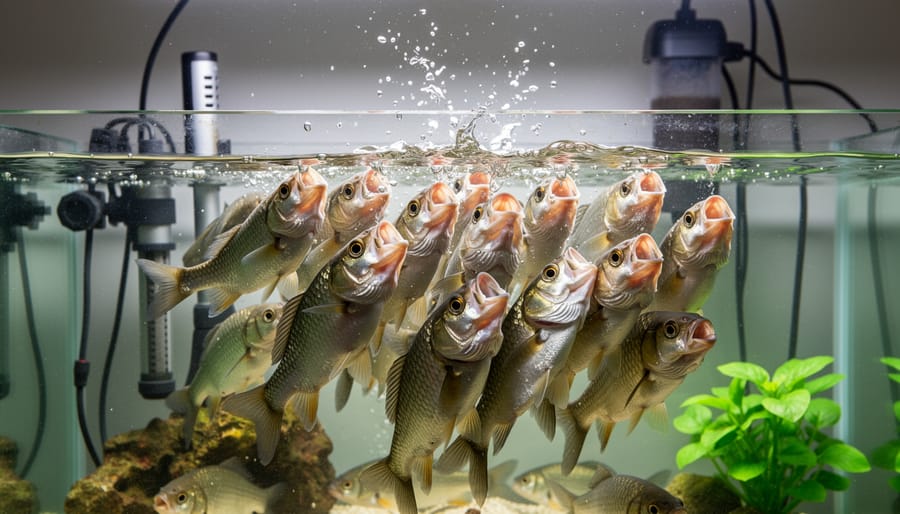
Pay close attention to your fish behavior too. Overcrowded fish often hang out near the surface, gulping air like they’re trying to catch their breath. That’s because dissolved oxygen levels drop when there are too many fish competing for the same resources. You might also notice your fish becoming listless or hovering in one spot instead of swimming around actively. Some may even start fighting more frequently over territory and food.
Here’s something many pond owners miss: fish that seem perpetually hungry or desperate at feeding time. In an overcrowded environment, competition for food becomes intense, and some fish may be getting pushed out entirely. You’ll also see stunted growth, where your fish just aren’t developing the way they should.
Algae blooms are another telltale sign. While some algae is normal, sudden explosions of green, slimy growth covering your pond’s surface indicate excess nutrients from fish waste overwhelming your system. These blooms can further deplete oxygen levels, creating a vicious cycle alongside other common pond dangers.
Finally, watch for disease outbreaks. Overcrowded conditions stress fish immune systems, making them vulnerable to infections that spread rapidly through the population. If you’re treating diseases more frequently than before, overcrowding might be the underlying culprit.
The good news? Catching these warning signs early gives you time to take action and restore balance to your pond ecosystem.
How to Support a Population of 250 Fish
Filtration and Aeration Upgrades That Actually Work
When you’re housing 250 fish, your pond’s filtration system becomes your best friend—and it needs to be working overtime. I learned this the hard way when my goldfish population exploded one summer, and my trusty little box filter just couldn’t keep up. The water turned murky within days, and I knew I had to upgrade fast.
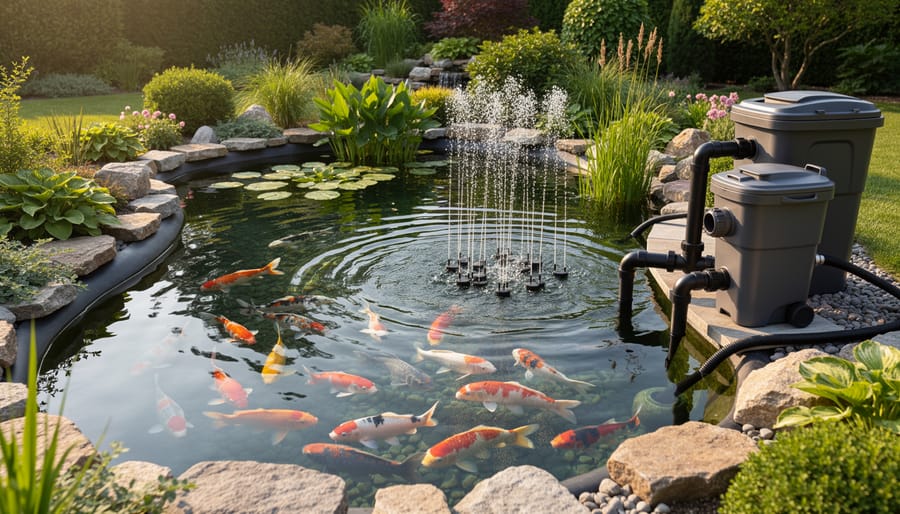
For a high-density fish population, you’ll need a filtration system that can cycle your entire pond volume at least once every two hours. That means if you have a 2,000-gallon pond, you’re looking at a pump rated for at least 1,000 gallons per hour. Choosing the right filtration system involves both mechanical and biological components—mechanical filters catch solid waste, while biological filters house beneficial bacteria that break down harmful ammonia.
Budget-friendly pressurized filters work wonderfully for ponds up to 5,000 gallons and typically cost between $200-$400. They’re easy to clean and maintain, which you’ll appreciate when you’re doing weekly maintenance. Pair this with a separate UV clarifier (around $100-$150) to control algae blooms that often plague heavily stocked ponds.
Aeration is equally critical. Add an air pump with multiple air stones positioned around your pond. This costs roughly $50-$100 but makes an enormous difference, especially during hot summer months when oxygen levels naturally drop. I run mine 24/7 during summer, and my fish are noticeably more active and healthy.
If you’re working with a tighter budget, explore various filtration options like DIY barrel filters using plastic media—they’re surprisingly effective and cost under $100 to build.
Feeding Strategies for Large Populations
Feeding 250 fish might sound daunting, but here’s some good news: it’s actually easier than feeding smaller populations once you understand the basics. The key is working smarter, not harder, while keeping your water crystal clear.
Think of feeding large populations like hosting a big dinner party. You wouldn’t dump all the food on the table at once, right? The same principle applies here. Feed smaller amounts multiple times daily rather than one large feeding. For 250 fish, aim for 2-3 feedings spread throughout the day, offering only what they can consume in 3-5 minutes. I learned this the hard way when my pond turned murky green after overfeeding my first large population!
Seasonal adjustments make a huge difference. During warm summer months when fish are most active, you can feed more frequently. As temperatures drop below 15°C (60°F), reduce feeding to once daily or every other day. Below 10°C (50°F), stop feeding entirely as fish metabolism slows dramatically.
Here’s a practical tip: invest in an automatic feeder for consistency, especially if you travel frequently. Position feeding stations at different pond areas to reduce competition and ensure all fish get their share.
Watch for uneaten food settling on the bottom, a telltale sign you’re overfeeding. Following proper feeding practices prevents ammonia spikes and maintains healthy water parameters. Remember, slightly underfed fish are healthier than overfed ones, and your pond ecosystem will thank you.
When (and How) to Reduce Your Fish Population
Sometimes, despite your best efforts, you’ll realize your pond has simply reached its limit. The good news? You have compassionate options for managing an oversized fish population.
I learned this lesson firsthand a few years back when my breeding koi went a bit too enthusiastically into reproduction mode. Within two seasons, my comfortable population of 80 had ballooned to nearly 200, and I noticed my filtration system struggling to keep up. The water stayed cloudy, and my fish seemed less active than usual. It was time to make some tough but necessary decisions.
The first step is finding good homes for your excess fish. Local pet stores often accept healthy pond fish, especially goldfish and koi, though they may not offer payment. Call ahead to check their policies and current needs. Some stores will only take fish during certain seasons or if they’re specific sizes.
Aquarium clubs and pond societies in your area can be goldmines for rehoming opportunities. Members are often looking to add fish to their own ponds and will appreciate healthy, well-cared-for stock. Post on community social media groups or local classifieds with clear photos and honest descriptions of your fish.
Consider offering fish to friends, neighbors, or family members who have ponds. When I rehomed my excess koi, three neighbors jumped at the chance to add some colorful residents to their water features.
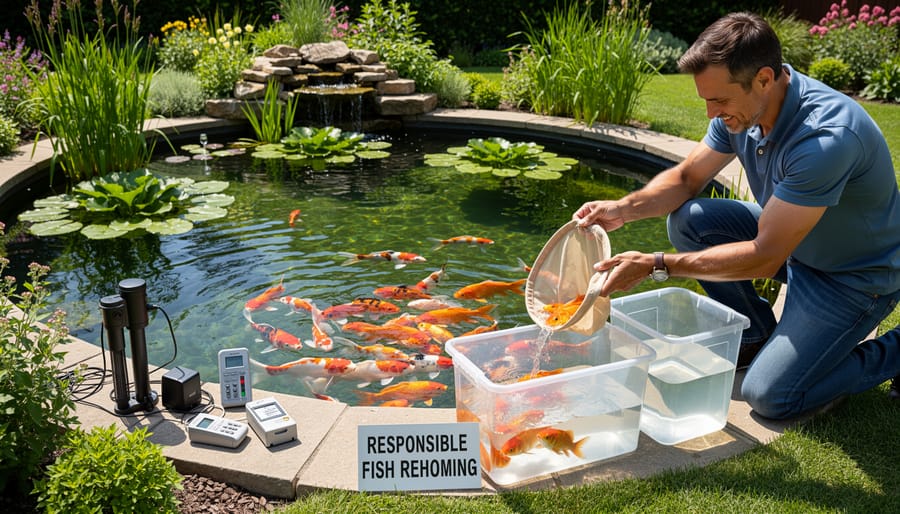
If you’re reducing your population, do it gradually rather than all at once. Removing too many fish quickly can actually throw off your pond’s biological balance. Aim to relocate 20-30 fish at a time over several weeks.
Transport fish responsibly in oxygen-packed bags or buckets with battery-powered aerators. Never release pond fish into natural waterways, as this can devastate local ecosystems and is illegal in many areas.
Remember, responsible population management isn’t failure. It’s good stewardship that ensures every fish in your care can thrive.
Here’s the thing I’ve learned after years of managing ponds: there’s no magic number that works for everyone. Whether 250 fish is right for your pond isn’t something you’ll find in a textbook. It’s something you’ll discover by watching your pond and listening to what it tells you.
Instead of obsessing over that specific number, focus on what you can actually observe. Are your fish active and healthy? Is the water reasonably clear? Can you maintain stable water parameters without constant intervention? These signs matter far more than any arbitrary population count. I’ve seen 300 fish thrive in one pond while another struggled with just 150, simply because the pond conditions were different.
Your action plan moving forward should be straightforward. Test your water weekly, especially ammonia, nitrite, and dissolved oxygen levels. Watch your fish during feeding time. Are they all coming to eat with enthusiasm? That’s a good sign. Are some gasping at the surface or hiding? Time to investigate. Keep an eye on algae growth and water clarity. A little algae is normal and even beneficial, but excessive blooms signal an imbalance.
Remember that pond keeping is a journey, not a destination. You’ll make adjustments along the way, and that’s completely normal. Maybe you’ll decide to rehome a few fish, or perhaps you’ll upgrade your filtration. Both choices are perfectly valid.
The beauty of pond keeping lies in creating a sustainable ecosystem that brings you joy. Trust your observations, stay consistent with maintenance, and don’t be afraid to make changes when your pond asks for them. You’ve got this.