
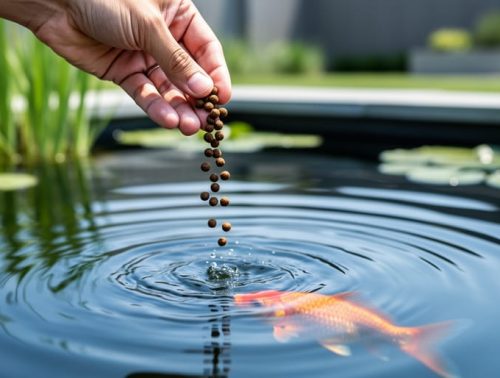
Aqua Care Sinking Pellets Goldfish 53g Review: A Simple Pond Feed Worth Trying?
Aqua Care Sinking Pellets Goldfish 53g is a solid, no-fuss choice for goldfish keepers who want a simple sinking pellet that suits how goldfish actually…
Aqua Care Sinking Pellets Goldfish 53g is a solid, no-fuss choice for goldfish keepers who want a simple sinking pellet that suits how goldfish actually…

A 3-acre pond sits right at the crossroads where homeowner aerators meet commercial-grade systems, and choosing the wrong one means wasted money and a struggling pond. Your pond needs roughly 9-12 horsepower of aeration to maintain healthy oxygen levels throughout the water column, which translates to either multiple smaller units or one powerful system working around the clock.
Size matters more than you think. Unlike smaller backyard ponds that can get by with decorative fountains, your 3-acre water body experiences stratification, where warm oxygen-poor water sits on top while cold, stagnant water lurks below. Without proper …
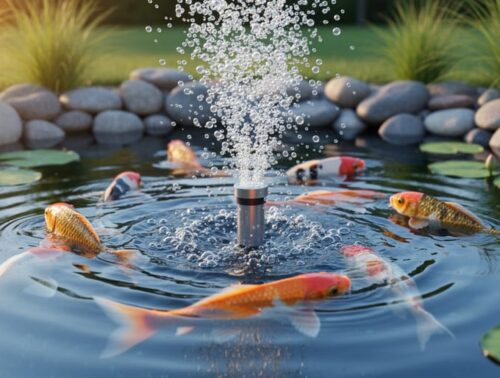
Watch your pond closely on a warm summer morning. If your fish are gasping at the surface or you’ve noticed murky, foul-smelling water, your pond is silently suffocating. The culprit isn’t disease or overfeeding—it’s depleted oxygen levels, and an aeration pond pump is the lifeline your underwater ecosystem desperately needs.
Think of aeration as your pond’s respiratory system. Just like you need fresh air to thrive, fish, beneficial bacteria, and aquatic plants require dissolved oxygen to survive. Without adequate circulation, stagnant water becomes a breeding ground for algae, harmful gases accumulate at …

Match your solar aerator’s output to your quarter-acre pond by calculating you need at least 0.5 to 1.0 CFM (cubic feet per minute) of air output for effective oxygenation. Check product specifications carefully, as many solar aerators designed for small decorative ponds won’t provide sufficient power for your water volume, which equals roughly 325,000 gallons in a pond with average depth.
Position your solar panel in a south-facing location that receives at least 6-8 hours of direct sunlight daily, even if this means placing it up to 100 feet away from your pond using extension cables. The distance is worthwhile because…

Look into your aquarium right now. If you’re seeing a cloudy green haze or milky water that won’t clear up no matter how often you change the water, you’re dealing with free-floating algae or microscopic organisms that standard filters can’t catch. A UV clarifier might be exactly what you need—and it’s easier to use than you think.
UV clarifiers work by passing your aquarium water through a chamber containing an ultraviolet light bulb. As suspended algae cells and bacteria flow past this light, the UV rays scramble their DNA, causing them to clump together or die off. Your regular filter then catches …

Picture your pond in late summer: fish gasping at the surface, murky water, and that telltale swamp smell wafting across your yard. I’ve been there, watching my beautiful koi struggle while my electric bill climbed from running a traditional aerator 24/7. That’s when I discovered solar-powered pond aerators, and honestly, they changed everything about how I maintain my water feature.
Solar aerators harness sunlight to pump oxygen into your pond without adding a cent to your utility costs. They work by converting solar energy into power that runs an air pump, which pushes bubbles through diffuser stones at the bottom of …