
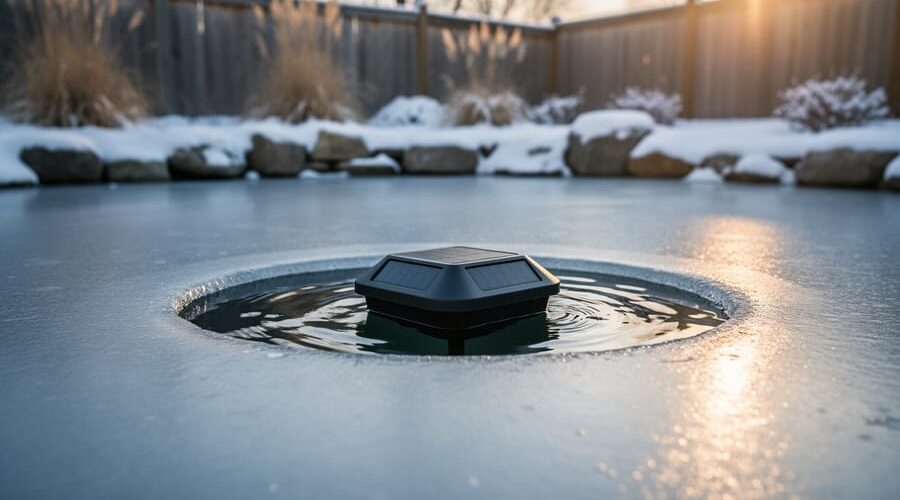
Keep Your Winter Pond Running Without Sky-High Electric Bills
Winter pond care doesn’t have to mean skyrocketing electricity bills or daily ice-chopping marathons. Solar pond de-icers harness free energy from the sun to keep a breathing hole open in your frozen pond, protecting your fish and beneficial bacteria from deadly oxygen depletion without adding a penny to your power costs.
These clever devices work by absorbing sunlight and converting it to heat, creating a small ice-free zone where toxic gases escape and fresh oxygen enters. Unlike traditional electric de-icers that run continuously, solar models operate independently, making them perfect for remote ponds or areas where running extension cords turns into a winter hazard.
But here’s the honest truth: solar de-icers aren’t magic solutions for every situation. They work brilliantly in regions with moderate winters and decent sunlight, but struggle during prolonged cloudy spells or extreme cold snaps. Understanding their capabilities and limitations before you buy saves frustration and potentially your fish’s lives.
This guide walks you through everything you need to know, from how the technology actually works to choosing the right model for your climate, installing it correctly, and knowing when you might need backup heat. Whether you’re embracing eco-friendly pond keeping or simply want a hassle-free winter solution, you’ll discover if solar de-icing fits your backyard reality.
Why Your Pond Needs a De-Icer (Even If You Don’t Think It Does)
You might be thinking, “My pond’s been fine every winter without a de-icer, so why bother now?” I get it—I thought the same thing until I learned what was really happening beneath that beautiful frozen surface.
Here’s the thing: when ice completely seals your pond, it creates an airtight cap. Toxic gases like ammonia and carbon dioxide that naturally build up from fish waste and decomposing organic matter become trapped underwater with nowhere to escape. At the same time, oxygen can’t get in. Even if your fish are hibernating and need less oxygen, they still need some, and proper gas exchange for fish survival is absolutely critical. Without a hole in the ice, you could lose your entire fish population without even knowing there’s a problem until spring thaw.
But it’s not just about fish. Ice expansion is seriously powerful—it can crack concrete, tear pond liners, and damage expensive pumps and filtration systems. I’ve seen beautiful stone edging pushed out of place and waterfalls ruined because expanding ice had nowhere to go. A de-icer creates that essential pressure-relief zone.
If you run a waterfall or fountain during winter, keeping a section ice-free maintains crucial water circulation. Frozen pumps mean costly repairs or replacements, and stagnant water accelerates ice buildup.
Think of winter pond maintenance like insurance—you don’t need it until you desperately do. A de-icer is your pond’s safety valve, protecting your investment, your fish, and all the hard work you’ve put into creating your water feature. Even mild winters can bring surprise cold snaps, and one prolonged freeze is all it takes.
How Solar Pond De-Icers Actually Work
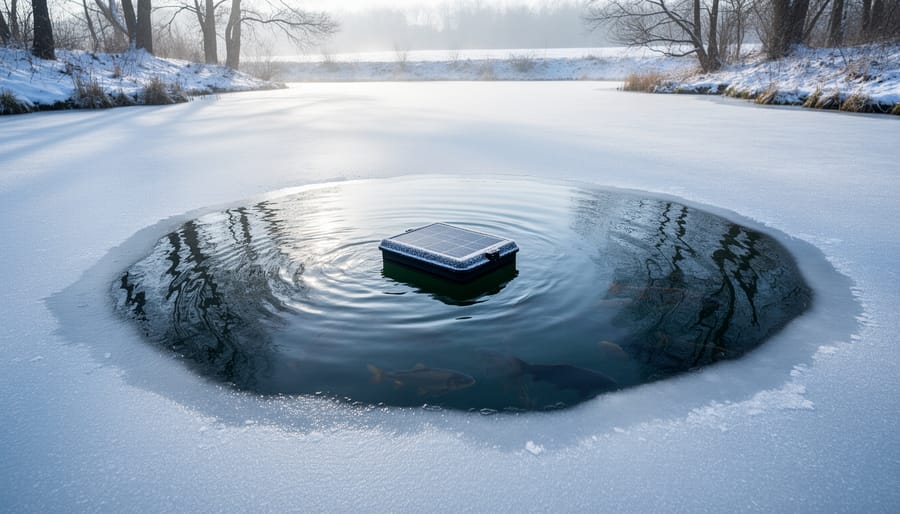
Here’s the wonderful part – solar pond de-icers are surprisingly straightforward! Think of them as self-contained little winter warriors that harness the sun’s energy to keep a small area of your pond ice-free.
The magic happens in three simple steps. First, the solar panel (usually mounted on a float or installed nearby) captures sunlight throughout the day. Even on cloudy winter days, modern panels can collect enough energy to keep things running. Second, this captured solar energy gets converted into electrical power that charges a built-in battery. This battery is your secret weapon because it stores energy to keep the system working overnight or during stretches of gray weather. Third, the stored power runs a small heating element positioned just below the water’s surface, which gently warms the water around it.
Now, here’s something important to understand – these devices aren’t designed to heat your entire pond. That would require massive amounts of energy! Instead, they maintain a single ice-free opening, typically 12 to 24 inches across. I like to call this your pond’s “breathing hole.”
Why does this matter? When ice covers your pond completely, harmful gases from decomposing organic matter get trapped below. Fish and beneficial bacteria need that opening for gas exchange. Your solar de-icer creates this critical opening without running up your electricity bill or requiring extension cords stretched across your yard.
The Real Benefits of Going Solar for Your Pond
No Extension Cords Across Your Yard
One of my favorite things about solar pond de-icers? No more worrying about tripping hazards or running extension cords through the snow! If you’ve ever dealt with traditional electric de-icers, you know the struggle of routing cables from your house to a distant pond, especially when that distance keeps growing as you add more features to your water garden.
Solar de-icers eliminate this headache entirely. They’re completely self-contained, drawing power directly from the sun rather than your electrical outlets. This means no exposed cords for kids or pets to stumble over, no electrical connections that could get wet or buried under snow, and no need to worry about outdoor outlet placement.
For ponds tucked away in corners of your property or seasonal water features that you only maintain part-time, this cordless freedom is genuinely liberating. You can position your de-icer exactly where it’s needed without compromising on safety or convenience. Plus, you’ll avoid that nagging winter worry about whether frozen precipitation has compromised your electrical setup.
Set It and Forget It
One of my favorite things about solar pond de-icers is how hands-off they are once you’ve got them set up. These clever devices use built-in sensors to turn on automatically when temperatures drop near freezing and sunlight hits the panel. When the sun goes down or conditions warm up, they simply power down on their own. No timers to program, no switches to flip every morning and evening.
I’ll be honest – the first winter I used one, I found myself checking on it constantly out of habit. But after a few days, I realized it was doing its job perfectly without any help from me. The solar panel soaks up whatever daylight is available, even on cloudy winter days, and the unit kicks in exactly when your pond needs it most. It’s genuinely a set-it-and-forget-it solution that lets you focus on enjoying your pond rather than babysitting equipment all winter long.
Eco-Friendly Water Gardening
Choosing a solar pond de-icer is one of the best decisions you can make for your pond and the planet! I love how these devices align perfectly with sustainable gardening practices, giving you peace of mind while protecting your fish. Once you’ve got your unit set up, there are zero ongoing electricity costs, which means your winter pond care becomes completely free to operate. The environmental benefits are genuinely impressive too. By harnessing the sun’s energy, you’re eliminating carbon emissions that traditional electric de-icers produce throughout winter. Many pond owners who’ve already made the switch to solar water features and de-icers tell me they feel great knowing their beautiful backyard oasis isn’t contributing to their carbon footprint. It’s a simple change that makes a real difference.
Perfect for Off-Grid or Remote Ponds
This is where solar pond de-icers truly shine! If your pond is tucked away at your cottage, sits at the back of your country property, or graces a remote corner of your land, running electrical wiring can be expensive, complicated, or downright impossible. I’ve talked with so many pond owners who assumed they had to choose between costly electrical installation and just crossing their fingers through winter.
Solar units eliminate that headache completely. No trenching for cables, no hiring electricians, and no permitting hassles. Just position your de-icer where it gets good sun exposure, and you’re set. For seasonal properties like cottages where you’re not around to monitor things daily, the set-it-and-forget-it nature of solar is especially appealing. Plus, there’s something wonderfully satisfying about knowing your pond is running on pure sunshine, even when you’re miles away. It’s independent, sustainable, and refreshingly simple.
Choosing the Right Solar De-Icer for Your Setup
Pond Size and Depth Considerations
Here’s the thing about pond size: it’s absolutely crucial when choosing your solar de-icer, and I learned this the hard way my first winter as a pond keeper! Think of your pond like a giant cup of coffee. A small cup cools down way faster than a big thermos, right? Same principle applies here.
Shallow ponds freeze faster because there’s simply less water volume to hold heat. If your pond is less than 18 inches deep, you’re working against Mother Nature in a big way. A 100-gallon pond will develop ice much quicker than a 500-gallon one, even in identical weather conditions.
When matching wattage to your water body, use this friendly rule of thumb: you’ll need roughly 100-150 watts per 1,000 gallons for milder climates. Colder regions might require 200+ watts. For smaller preformed ponds around 50-150 gallons, a 50-watt solar de-icer can work beautifully. Larger koi ponds exceeding 1,000 gallons? You’re looking at multiple units or a higher-wattage system.
Measure your pond’s dimensions before shopping. Calculate volume by multiplying length times width times average depth, then multiply by 7.5 for gallons. This simple math ensures you’re not underpowered when January arrives with its icy grip.
Your Winter Climate Reality Check
Let’s be real for a moment—solar pond de-icers aren’t magic. If you live in Minnesota or Alaska where temperatures plunge to -20°F for weeks on end, a solar unit alone might struggle to keep up. These devices work beautifully in moderate winter climates or as supplemental heating, but extremely cold regions with limited sunlight hours present genuine challenges.
Most solar de-icers are rated for temperatures down to about 0°F to -10°F, depending on the model. Check the manufacturer’s specifications carefully and compare them to your area’s typical winter lows. If you’re borderline, consider starting with a solar unit and keeping a traditional electric de-icer as backup for those brutally cold snaps.
Cloudy, overcast weeks also reduce solar efficiency. During prolonged gray periods, your unit might not generate enough warmth to maintain an opening. This doesn’t mean solar won’t work for you—just that you might need a hybrid approach.
The good news? Many pond keepers successfully combine solar and electric systems, using solar as their primary solution and switching to electric only when Mother Nature gets particularly grumpy. It’s all about knowing your climate’s personality and planning accordingly.
Float Style vs. Submersible Models
When shopping for solar pond de-icers, you’ll encounter two main designs, and understanding the difference will help you pick the right one for your setup.
Float-style de-icers sit right on the water’s surface, looking a bit like a floating hockey puck with a solar panel on top. These are fantastic for most backyard ponds because they’re incredibly easy to use. Just place them in the water, and you’re done! They naturally stay at the surface where they can maintain that crucial opening for gas exchange. The downside? In really windy conditions, they can drift around your pond unless you tether them loosely to prevent them from getting stuck in corners.
Submersible models hang beneath the surface, suspended by a float or mounting system. These work beautifully in deeper ponds where you want the heating element positioned at a specific depth. They’re also great if you’re concerned about aesthetics since they’re less visible. However, they require a bit more installation effort and careful positioning to ensure they’re effective at preventing ice formation at the surface.
For most beginner pond keepers with standard garden ponds up to 500 gallons, I’d recommend starting with a float-style model. They’re forgiving, relocatable, and let you experiment with placement easily. Save submersibles for larger, deeper installations where precise positioning matters.
Installing Your Solar Pond De-Icer (The Easy Way)
Positioning Your Solar Panel
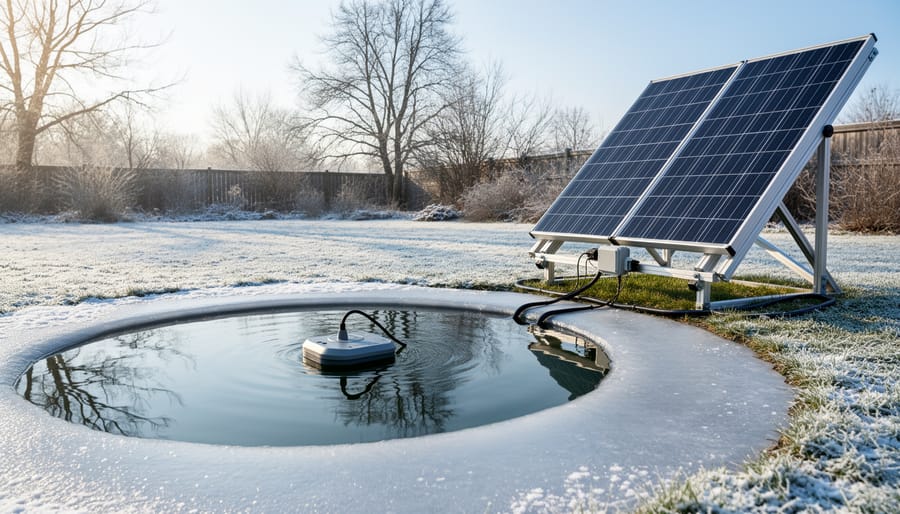
Getting the most from your solar panel is all about finding that sweet spot for sunlight. During winter months, the sun sits lower in the southern sky, so positioning your panel to face south will give you maximum exposure. If your pond is surrounded by trees or structures, take a walk around it at midday to see where the sun actually hits—you might be surprised at how shadows shift in winter compared to summer.
Angling matters too. Most solar de-icer panels work best when tilted at about 45-60 degrees in winter, helping them catch those low-angle rays more directly. Many units come with adjustable stands, so don’t just set it flat on the ice and call it a day.
Wind can be your enemy here. I learned this the hard way when I found my panel floating across the pond one breezy January morning! Use the included stakes or weights, and if your model doesn’t have them, consider securing it with fishing line tied to nearby posts or heavy rocks at the pond’s edge.
Finally, think about your cable routing. Keep the cord from the panel to the de-icer unit as short as possible to minimize energy loss, but make sure it won’t create a tripping hazard or get buried under snow where you can’t monitor connections.
Placing the De-Icer Unit
Getting your solar de-icer positioned correctly makes all the difference in how well it performs. You’ll want to place it where your pond naturally receives the most sunlight during winter months, typically away from overhanging trees or structures that cast shadows.
For depth, aim to position the unit just below the water’s surface, usually 6-12 inches down. This placement allows it to keep that crucial opening in the ice while staying submerged enough to work efficiently. Most units come with adjustable floats that make finding this sweet spot pretty straightforward.
Here’s something I learned the hard way: keep your de-icer away from areas where fish tend to congregate during winter. Fish naturally seek deeper, calmer waters in cold months, so positioning your unit near the pond’s edge or shallower areas works best. This prevents drawing fish to the coldest part of your pond.
Anchoring is essential since you don’t want your de-icer drifting around. Many models include tethers or stakes, but you can also use fishing line tied to a nearby rock or stake. Just make sure it’s secure but allows for minor water level changes.
Before the first freeze arrives, test your unit on a sunny day to confirm it’s working properly and positioned where it’ll get maximum sun exposure throughout winter.
Getting the Most from Your Solar De-Icer
Keep That Panel Clean
Here’s the thing about solar panels—they only work when sunlight actually reaches them! I learned this the hard way during my first winter with a solar de-icer. After a heavy snowfall, I couldn’t figure out why my unit stopped working until I trudged outside and found the panel completely buried under a white blanket.
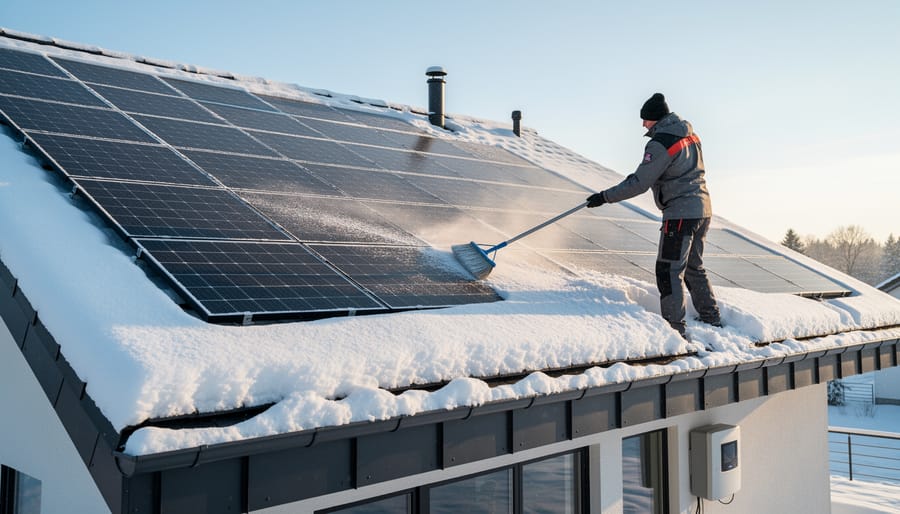
Snow, ice, leaves, and even bird droppings can slash your panel’s performance by 50% or more. Make it a habit to check your panel every few days during winter, especially after storms. A quick brush-off with a soft broom or squeegee takes just minutes and keeps everything running smoothly.
When you’re setting up your system, think about accessibility. Don’t mount your panel somewhere you’ll need a ladder to reach in icy conditions—that’s asking for trouble! Position it where you can safely reach it from the ground or a sturdy platform. Keep a long-handled brush nearby specifically for panel maintenance. Trust me, future you will appreciate the thoughtful placement when you’re doing quick clean-ups in freezing temperatures while still in your pajamas and winter coat!
Combining with Other Winter Strategies
Here’s the thing about winter pond care – it’s not an either-or situation! Your solar de-icer works even better when you team it up with other winterizing strategies. Think of it as creating a comprehensive support system for your pond.
Pond netting is a fantastic partner for your solar de-icer. The netting catches falling leaves and debris before they sink and decompose, while your de-icer keeps that crucial gas-exchange hole open. Together, they’re like a one-two punch for water quality.
If you’ve got fish overwintering in your pond, consider pairing your solar unit with an aerator. The aerator circulates oxygen throughout the water column, while the de-icer maintains surface access. I’ve found this combination especially helpful in deeper ponds where a single de-icer might not reach the bottom layers.
Strategic placement makes a huge difference too. Position your solar de-icer near waterfalls or fountain areas if you’re running them on mild winter days. The moving water naturally resists freezing, and your de-icer reinforces that effect. Just remember that waterfalls should typically be shut down during hard freezes to prevent ice dams.
The beauty of combining strategies is redundancy. If one system struggles during an especially brutal cold snap, you’ve got backup protection keeping your pond healthy.
When Solar Might Not Be Enough (And What to Do)
Let me be honest with you – solar de-icers aren’t magic wands. I learned this the hard way during a particularly brutal cold snap three winters ago when my solar unit just couldn’t keep up with temperatures hovering at -15°F for nearly a week. The sun barely peeked through heavy cloud cover, and my poor koi pond started icing over despite my best efforts.
Here’s the reality: solar de-icers work beautifully under normal winter conditions, but they have their limits. If you live in areas with extreme cold, experience extended cloudy periods, or maintain a pond larger than 1,000 gallons, you might need backup support.
That’s where hybrid systems come in handy. Many pond keepers (myself included) now run a dual-power setup. Your solar de-icer handles day-to-day winter maintenance, while a traditional electric de-icer stands ready as backup during harsh conditions. You can also position a supplemental bubbler or aerator in deeper areas where solar units might struggle to reach.
For very large ponds, consider installing multiple solar units at different locations rather than relying on one device. Think of it as teamwork – they share the workload.
The key is knowing your pond’s needs and your local climate patterns. There’s no shame in using traditional methods when necessary. The goal is keeping your fish safe and your pond healthy, whether that’s through solar power, electricity, or a smart combination of both.
Making the switch to a solar pond de-icer isn’t just a smart move for your pond—it’s a smart move for your wallet and the planet. I’ll be honest, when I first tried solar technology in my own backyard water garden, I was skeptical. But watching that little unit quietly do its job all winter while my electric bill stayed put? That’s when I became a believer.
These devices represent exactly the kind of practical innovation modern water gardeners need. You’re protecting your fish, maintaining pond health, and supporting your ecosystem without constantly worrying about power consumption or finding outdoor outlets. The peace of mind knowing your pond stays safe through those brutal cold snaps, all powered by nothing but sunlight, is genuinely satisfying.
If your pond fits the criteria we’ve discussed—reasonable size, decent sun exposure, and moderate climate—there’s really no reason not to give solar a try as your primary de-icing solution. Start with realistic expectations, position your unit thoughtfully, and you’ll likely wonder why you didn’t make the switch sooner. Your pond investment deserves this kind of care, and doing it sustainably just makes the whole experience better.